Sunday, March 3, 2019

Fouzia Hussain- Changes in Roles of Women

Fouzia Hussain
Gender Roles, Subject, and Power
Art and Women
3 March 2019
Change in Roles of Women
Women during the Middle Ages was a rough time because they did not receive the same rights as a female than men do. Women were treated as objects and were taught to be “submissive” to their husband. Women were forced to grow in a patriarchal culture where they had to obey all the men in their lives. For instance, women were told that their only job was to cook, clean, and take care of the kids. Chadwick stated, "Rousseau not only believed women to be naturally inferior and submissive, but he also put great emphasis on the notion that the sexes should be separated. Believing that women lacked the intellectual capacities of men, he argued that they had no ability to contribute to art and the work of civilization apart from their domestic roles” (39). Men like Rousseau during the Middle Ages explains the patriarchy that was occurring towards females. He believed that women can not do the same job as a man, he believed that women should focus to only be the caretaker. Separating the “roles” of men and women at this time was crucial, women did not have the same rights as men. They were rejected from expressing their talent through art and paintings. However, the only way women were ever allowed to take control was if their husbands have gone to war. That is the closest they ever got to managing. Also, it came to the point that women decided to become nuns or make their children turn into nuns. This way, they would “escape” the mistreatment, being “submissive”, and rape. This would help women to stay away from men and not to follow their orders. A part of a role to become a nun is not getting married. This helped some women escape from men because they did not have to deal with their “role” (which is to be a housewife) of marriage. Furthermore, women did not have the right to get an education. They were told that this would make them forget their duty as a mother. Guerilla Girls stated, “Education was thought to interfere with a woman’s ability to be a good wife and mother. Almost no women were taught to read and write” (22). This was unfortunate for women during the Middle Ages because they were forbidden to get knowledge and become smart. Women were able to express their art and work in different ways such as sewing, needlework. Women were allowed to work in convents that allowed them to express themselves. Chadwick stated, “The division of labor according to sex is a modern invention, often manifested in attempts to identify female sexuality with activities like needlework” (63). As mentioned before, most women were able to do was handcrafted work that men were not able to do like needlework. Women were needed for this. Both these images are portraying the same meaning but from a female artist and a male artist.

For instance, the first picture was painted by a male artist, Tintoretto. In this painting, it is showing the needlework women are doing similar to the second painting made by Judith Leyster, a female artist. However, the difference between these two paintings is that the male painting shows color, wealth, and comfort while doing her work. However from a female’s perspective, that women are in a dull, dark mood setting, uncomfortable doing her work and not as wealthy as the first painting.

The way men painted was different from how females did. Men portray a different expression in their paintings while females express the real expression, how women feel and what they go through. Men tend to express a different message in their work that's showing “lies” when women express the real message. Most women were refused to share their art because men did not want them to be as superior as well as telling the truth. In other words, when women paint, they describe what their sorrows and what they have to deal with and at this time women were refused to show their work which was upsetting.
   Until then, things were able to change just a little later on. During the Renaissance, women were able to receive a little more rights but not as much. In the Guerrilla Girls, it started, “One of the few ways a woman could work as an artist was to be born into a family of artists that needed assistance in the family workshop” (29). Although women were still strictly forbidden from working, towards the renaissance they were able to move just a little up. N example of this is the Gentileschi family. Orazio Gentileschi and Artemisia Gentileschi came from the same family.

First Painting is painted by Orazio Gentileschi describing the painting more in a calmer tone as if their not as scared. The colors show more light and less darkness.
A second painting by Artemesia Gentileschi is vaguer and painted by the daughter. This one shows a difference in tone and expression. In this painting, it describes the fear the women are in and trying to hide the “beheaded”.
Here’s a link down below of a small summary of the meaning behind these paintings and the difference:
http://www.angelfire.com/co4/kerianne/web4.htm

During the Renaissance, many women have still struggled to survive and live for their passion for art. In the Guerilla Girls, it stated, “Onorato Rodiani abandoned a promising career as a painter when she killed a colleague who tried to rape her. Rather than stand trial for murder, she fled and spent 20 years in drag as a professional soldier. Her real sex was discovered at her death” (30). It’s so unfortunate of what level women had to go to, in order to save themselves. In this case, this woman changed her whole identity. During the Renaissance, women got the chance to go to school as well and move forward with their passion for art. Chadwick stated, “Bologna was unique among Italian cities for having both a university which had educated women since the Middle Ages and a female saint who painted” (87). In the Renaissance, education even expanded for women. The transition from the Middle Ages to the Renaissance was a slight change but women were still treated as if they could not accomplish the same as men.
A link below is the university that women were able to attend:

Saturday, March 2, 2019

Post 2: Gender Roles, Subject, & Power

The role of women changed from the Middle Ages to the Renaissance period up until the 19th century. Each of these periods in Europe signified a great change in the expectations and behavior of women. These patterns can also be found in the way art was developed by women and the connotations these paintings have behind them.


Image result for hildegard of bingen scivias
In the Middle Ages, women had little to no rights with almost everything. A women’s life was already predetermined for her the minute she was born. “Women were usually engaged to be married at age 12 and were married by 15” (Guerrilla Girls 22).  After women were engaged and married, their entire lives revolved around satisfying that man in every possible way. A women’s happiness in the relationship was not something to worry about, because even if she was unhappy there was nothing she could do about it. Obedience was the biggest thing for a woman during this time and they were taught to always obey the men in their households and have no objection to the life that they were living. Power only existed for women if they were a woman of the Church, which meant they had to be a nun. Nuns made it their priority to sacrifice their lives to the dedication of the Church. Eventually, nuns were able to use convents as a place where women were able to get together and receive the education that they were deprived of in the outside world. “The presence of well-endowed convents during the eleventh and twelfth centuries encouraged large numbers of women to take up religious lives: cults of female saints” (Chadwick 53). Since convents were the only place women were allowed to show any type of creativity or intellectuality, most art painted by a woman were found in these settings. The Hildegard of Bingen was one of the prominent female artists during this time whose painting was taken seriously. Hildegard’s Scivias paintings were important during the time because people believed that her illustrations had spiritual meanings due to her childhood visions of unusual lights. The Hildegard of Bingen introduced the power of women artists at the time, but there was still a very long way to go. 


Image result for hildegard of bingen scivias
Hildegard of Bingen – Scivias 1142-52
              Hildegard’s childhood visions of unusual lights and stars allowed the Church to believe that her paintings had a spirituality to them.


During the Renaissance period, women were still oppressed in their relationships, but this was more seen now in several painting that women had the liberty of creating. This period in Europe was interesting because the painting told domestic stories that women were not able to tell with words, so they did so with pictures. The position of a woman was always defined as first daughter, then wife, then mother but for a man, his position in society was always defined first by his occupation. Women were not even given the opportunity to have a career. Once married off, the duty of a wife begins and some of the great artists of the time showed through their paintings how women in the household were treated and how they felt about it. Women empowerment was visible through these beginning paintings because of artists like Artemisia Gentileschi and Elizabeth Siriani. Siriani paints a piece called Portia Wounding her Thigh which is a powerful depiction of women during the Renaissance period making it known that her gender does not stop her strength in any political or social discussion. If she has to stab herself to prove her physical strength compared to a man then she will. The women in the back of the painting are seen to be partaking in a stereotypical gossip session, but Portia is smarter than that and has more to her than gossip. She stabs herself as a metaphor to prove that she is tough and intelligent. Gentileschi also paints pieces that showcase women as more than obedient creatures who deal with the injustices thrown at them. She paints a version of Susanna and the Elders that showcase 2 grown men conspiring to either rape or sexually harass Susanna while Susanna faces away with rejection. This painting is powerful because it shows the predatory behavior of men at the time towards women and how they motivate each other to be disgusting towards women. Susanna looking away is a clear symbol of oppression and the helplessness that women at that time felt. 

Image result for susanna and the elders artemisia x ray
Image result for artemisia gentileschi susanna and the elders 1610 oil on canvas
Artemesia Gentileschi's, Susanna and the Elders 1610
Susanna looking away and the clear predatory behavior of men at the time. 
Image result for portia wounding her thigh elisabetta sirani
Elizabetta Siriani, Portia Wounding her Thigh 1664
Portia showing her husband Brutas that she is tougher and more capable 


During the 19th century, the role of men and women were very defined and things were very structural for both genders. Women were considered very important figures, but only in the household. It was understood that they were significant in a man’s life, but for the finer things like cooking, cleaning, and taking care of the kids. Education was more accessible to women now, but they were not expected to do anything with education other than teach the appropriate things to the children. Education and mannerism went hand in hand it became very important for women, to simply act and behave like a woman. This infuriated some empowering women and they challenged this concept with all their strength. Rosa Bonheur was a woman at the time who was so disgusted by the conditions that she was expected to live by, that she went out of her way to make it legal for herself to cross-dress and travel to different places to paint. She loved to paint animals and made it a priority to get her permit to travel freely and paint with her partner, Nathalie Micas. “She hunted, smoked cigars, and rode her horse astride through the streets of Paris” (Guerrilla Girls 48). Rosa was very interesting because she never married and she challenged the position a woman was expected to have in society.


Works Cited

         The Guerrilla Girls' beside Companion to the History of Western Art. 1998.
Chadwick, Whitney. Women, Art, and Society: Fourth Edition. Thames & Hudson, 2007.  


Gender Role, Subject, and Power

Juliana Ruperto
3-2-2019

The Middle Ages in Europe were a very oppressive time for women because they had to follow strict gender roles in a patriarchal culture. The feudal system of government restricted women to second class citizens, or as property to the men in their lives (i.e their fathers, brothers, or husbands). Young girls were groomed to become happy, homemaker housewives and bear children. They were not given the tools to become successful without a husband. Most women of the Middle Ages were illiterate because, “education was thought to interfere with a woman’s ability to be a good wife and mother” (Guerrilla Girls 22). However, education and knowledge can also be power, if women were given the proper education they would rebel against the oppressive norm, and of course men wanted to remain in control over women.
The only way women could educate themselves and gain freedom during this time, was to join a religious convent.“ Joining a convent freed women from demanding roles of being wives and mothers” (Guerrilla Girl 21). Women who chose to join a convent ultimately have to abandon the idea of ever getting marriage. They could not have both; it was either marriage or freedom. “During the Middle Ages, the convent provided an alternative to marriage, offering a haven for nonconformists and female intellectuals” (Chadwick 45). The nuns within these convents proved to be very talented. The only way for women to pursue an artistic career was to have an artistic father or join a convent.  
The Bayeux Tapestry is one piece of art that is credited to the nuns and needleworkers that were members of convents. Doing “women’s work” and join convents were really the only way women artist could express themselves during this time period. They were not given the credit they deserved. The Bayeux Tapestry is a huge piece of work depicting the events leading up to the Norman conquest of England. Below is just a small portion of the tapestry where Harold makes a solemn oath. Clink the link underneath the image to view the entire Bayeux Tapestry, section by section.  
 
Although joining convents was one of the major ways women during the Middle Ages pursued their artistic careers, it was not the only way. Although women were excluded from classical art styles, such as sculpting and painting, women were welcomed to participate in feminine artwork. These included needlework, silk making, and other crafts. Capitalism was being to evolve in Europe, and women wanted to participate. “The growth of towns during the thirteenth century created a new class of women- urban working women whose managerial skills were in great demand due to a high degree of mobility among men… the woman merchant had full civic status” (Chadwick 63). The merchant woman was a productive member of society; it was a new role for women, rather than just becoming a wife and a mother.
Leading into the Renaissance, women and female artist started to gain a little more freedom. “Painting became one of a growing list of activities in which women had intuitive, but not learned, knowledge and to whose laws they remained outsiders” (Chadwick 74). Women were still expected to get married and have children, but the idea of female artist was a little more welcomed by some. For the most part, it remained that the only way a woman could work as an artist was if she was born into a family of artists “that needed assistance in the family workshop” (Guerrilla Girls 29). Female artist received a lot of backlash and violence from their male peers. One famous male painter, Alberti, disapproved of women working as artist. He said, “Women’s virtues are chastity and motherhood; her domain is the private world of the family” (Chadwick 71). Like most men, he believed that the female artist was neglecting her household duties in the pursuit of a “man’s job.”
Similar to the Middle Ages, female artists of the Renaissance also had to choose between marriage or their career. Properzia De Rossi was the only known female sculptor of the time. Due to strict gender roles, she lived on her own, with no man to look after her; something very unusual at the time. Eventually she was accused of of being a prostitute. Being labeled ruined her reputation and ended her artistic career. A woman’s reputation was very crucial to her status in society, and once it was tarnished, it could never be repaired. Another way a woman’s reputation could be tarnished was rape.
Many female artist had some experience with sexual assault. Artemisia Gentileschi, was a teenage prodigy. Her father allowed her to utilize her artistic talents in his atelier. Artemisia was raped one day by Agostino Tassi, a colleague of her father. After the rape, Agostino offered to marry Artemisia because marriage was the only way her reputation would not be tarnished. However, Agostino rescinded his marriage proposal, and Artemisia’s father filed a lawsuit against him. As a woman, Artemisia could not file the lawsuit against him herself, it had to be a man. Ultimately Agostino was convicted for the rape, however, this traumatic event remained significant to Artemisia and it was reflected in her work. One of her famous paintings, shown below, “Judith Slaying Holofernes,” depicts Judith looking while she cuts the head off an Assyrian General after trying to seduce him. Artemisia paints judith looking as she decapitates this man to send a message that women are “unafraid to face carnage and death” (Guerrilla Girls 37). Clink the link to view more of Artemisia Gentileschi’s artwork:https://www.artsy.net/artist/artemisia-gentileschi


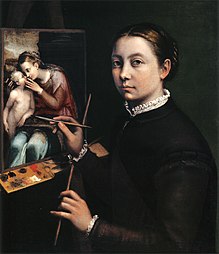
As you can see, women of the Renaissance were rebelling more and more against the social norm. They challenged the idea that women were only meant to marry and bear children. Female artist of this period portrayed women in a different light. Women were shown as strong, fearless, beautiful, independent, and so on. Another famous female portraitist, that was known for showcasing women in a different light, was Sofonisba Anguissola. Sofonisba was also born into a family of painters, she also received encouragement and praise from Michelangelo. Below is a painting, titled Self-Portrait, in this painting Sofonisba paints herself moderately dressed painting a picture of another woman. Most of her painting were of women, and of women with prestige and gracefulness. In a way, she was going against the male gaze because she knew men were watching but she painted women how they wanted to been seen, not how men wanted to see them. Her work and the work of many other women artist did not receive nearly enough of the credit they deserved, but they did begin to break down some of the stereotypical restrictions placed on women during the time.  
Image result for sofonisba anguissola


Works Cited
The Guerrilla Girls, The Guerrilla Girls’ Bedside Companion to the History of Western Art (New York, Penguin       Books, 1998)

Whitney Chadwick, Women, Art, and Society, 4th or 5th edition, (New York: Thames and Hudson), 2007.

Friday, March 1, 2019

Gender Roles, Subject, & Power

Nicole Altamirano
                 During the Middle Ages in Europe, women were expected to be submissive of men. Women had no rights to anything. Men were always superior to women. Women could not speak back to men unless they wanted trouble. The only job that was guaranteed for a woman was being a housewife or a caretaker. The only thing that they were able to manage was their household. The had to take care of their children and make sure their husbands were feed and food was ready by the time they got home. The only way that a women could survive in this era was by being married off or becoming a nun. For many there wasn't any other alternative. As Chadwick states "Rousseau not only believed women to be naturally inferior and submissive, but he also put great emphasis on the notion that the sexes should be separated. Believing that women lacked the intellectual capacities of men, he argued that they had no ability to contribute to art and the work of civilization apart from their domestic roles" (39).  As you can see women were very limited at this time. Their easier way to obtain an education was becoming a nun. The Guerrilla Girls state "Joining a convent freed women from the demanding roles of being wives and mothers... Nuns wrote books on medicine, science, and sacred music" (21).  The roles of women slowly began to change during the Renaissance and the 19th century.  Some women had the advantage to do things other women couldn't do. For example, if you were born in a wealthy family or if your family was artistic, there was a chance of you being noticed; and both was great. For example, Artemisia Gentileschi was at an advantage because she was the daughter of an artist Orazio Gentileschi. She worked along side with her father.
Image result for orazio gentileschi judith and holofernes
Orazio Gentileschi: Judith & Her Maidservant with Holofernes 
Image result for gentileschi judith and holofernes
Artemisia Gentileschi: Judith slaying Holofernes


 The city of Bologna was a progressive city aside from others at the time. Many women artists came to this place to make names for themselves. "The city of Bologna stood out from the rest of Europe in its attitude toward women. Women were admitted to its university beginning as early as the 13th century and were even permitted to lecture there" (Guerrilla Girls 30). Elisabetta Sirani was very famous in Bologna. She built an academy specifically for women artists. During the Renaissance things started to easy a bit for women but it was still hard for them to be their own individual. "Peasants, women, and the urban poor had no part to play in cultural renaissance oriented toward the growth and embellishment of the city as a mater of civic pride, and stressing a model of production in which man's creations paralleled those of God and carried with them the same implicit power over objects that wealth conferred" (Chadwick 70). Compared to "Not until the sixteenth century did a few women manage to turn the new Renaissance emphasis on virtue and gentility into positive attributes to the women artist. Their careers were made possible by birth into artist families and the training that accompanied it, or into the upper class where the spread of Renaissance ideas about the desirability of education opened new possibilities for women" (Chadwick 76). This is to say that during this time period the only way that women artists would be successful was if the had money. During these times not everyone was rich and social mobility was very hard.
           The 19th century was just the beginning to a fight towards equality. Women were starting to speak up about the struggles that they were going through. "Rosa [Bonheur] encouraged women to be rebellious saying 'Let women establish their claims by great and good works and not by conventions' " (Guerrilla Girls 49). Bonheur made paintings to show women's struggles against men. In her notable work The Horse Fair, we can see the wild horses fighting back in order for them to not be tamed by the men, which is the exact same thing that women are trying to do. As Chadwick mentions " Images of animals frequently symbolized the vices and virtues of women. Constantly exhorted to rise above their 'animal' natures, women were pursued by animal exemplars (192). Bonheur also cross-dressed in order for her to continue with her career. Not many women were able to do this but because of Bonheur's status and the support of her family she was able to do this. This was a form of some progression as well. Bonheur was very successful at her time. As the Guerrilla Girls mention " Her first success came at the age twenty-six, when she won a gold medal at the Salon of 1848. From this she received a commission from the French government ..." (47).
The Horse Fair
The Horse Fair 
Despite their challenges many women tried to survive by paintings to take care of their families once their partner was dead or absent. In the painting Nameless and Friendless, we can assume that the story of this painting is about a widow mother trying to sell her work to take care of her child, whom is accompanying her. Since it was hard for women to survive without their fathers or a husband, many had to find suitors very quick. Chadwick further explains the painting as "The painting is carefully structured to emphasize the commodification of women in the art trade and the isolation and helplessness of the single women in patriachal society (188).  Nameless and Friendless is a paining made by Emily Mary Osborn. "The message is clear: Women have no place in the commerce of art; they belong to the world of art as subjects, not makers or purveyors" (Chadwick 188). Women were viewed as a threat to men. Though today we still face the issues that women faced back then , "In 12th-century England, men were embroiderers too, and naturally, they got paid more: women earned only 83 percent of what men earned per day" (Guerrilla Girls 21). 
Nameless and Friendless. "The rich man's wealth is his strong city, etc." - Proverbs, x, 15
Nameless and Friendless


Links: 

^ detailed explanations of the life of women artists mentioned  above 
This link goes into depth with how most artists mentioned above faced challenges throughout their life time. 

Works Cited:
The Guerrilla Girls' beside Companion to the History of Western Art. 1998.
Chadwick, Whitney. Women, Art, and Society: Fourth Edition. Thames & Hudson, 2007.