Wednesday, April 10, 2019

Post 3 - Modernism / Postmodernism

     Modernism refers to the movement from the late 19th century to the mid-20th century where artists such as writers, painters, crafters, and filmmakers produced pieces that were meant to reflect the modern industrial time of the period. Times were changing and so were the intentions of the artist at the time, and they wanted to allow their creativeness to reflect all those things that were also changing. Many artists were able to take advantage of the industrial developments during the time and create pieces that told stories about those things. These pieces varied from political, cultural, and social changes and the objective of Modernism art was to allow historical art to remain history and make room for new techniques and styles to be introduced into the artistic world. Some of this art was introduced to make it seem more realistic instead of just two dimensional. Artists would also incorporate photography into the world of art and to showcase discrimination of the oppressed. Although often disregarded, women played a significant and necessary role during Modernism by describing the issues of female life in that society through their art. The introduction of women artist during the Modernism period is powerful because, through different techniques such as live performances, film, and photography, women were able to finally show people a visual representation of how they felt in a misogynistic society and how they are not satisfied with the gender stereotypes placed continuously on them.

     One of the artists during the time who broke the rules of complementary colors and color contrast was Sonia Delaunay. Sonia used different shapes and colors in her paintings to allow her audience to understand that art was more than just following rules and new forms of paintings to explain abstracts should be accepted. Her famous painting, Simultaneous Contrasts was so new and fresh in the art world that people were confused whether it should be hung vertical or horizontal. This confusion introduced an open-mindedness to the art world. Many people even call this painting one of the first paintings that entered abstract art. Since her technique was unorthodox, it was refreshing to see such different shapes and colors interact with each other to convey a strong message about the countless things you can do with art.
Sonia Delaunay, Simultaneous Contrast 1912
     Women during Modernism also wanted to give messages about how they feel about their sexuality, and how they can own the female nude in a way that does not objectify them for their bodies but appreciates them. Suzanne Valadon paints The Blue Room which is a very powerful piece with lots of feministic messages. The model in the painting is comfortable in her own body and owns her imperfections not to satisfy a man’s mind, but to simply live her life in her own skin. Her painting displays a woman in a natural setting, and her gaze is not towards the viewer but away, showing that she has her reasons to be lounging that has nothing to do with anyone else. Compared to the paintings during the Renaissance period, The Blue Room has more control of herself and is confident in her being there. This painting is a perfect perception of the modern woman.


Suzanne Valadon The Blue Room 1923
    Postmodernism was a period that followed directly after Modernism where artists focused on topics that had no definite meaning, and their pieces were meant to express whatever the individual decides to interpret it as. They were controversial, and Postmodernism pushed for a society to question the culture that they are in, and continuously challenge it. Postmodernism art encouraged people to find their truth through the art that they saw even if it is not conventional to the standards of the time. Women during this time made it a priority to allow themselves to be also be heard since the world still revolved around the messages men were making about Postmodernism and it is important to recognize that women played a significant role in the creation of fantastic pieces.

    A very famous performance art during this time was by Yoko Ono called Cut Piece. In this piece, she asked the audience in front of her to approach her and cut off part of her shirt if they were willing to with a pair of scissors. Many people in the audience obliged and did exactly that, while one man even cut off the straps of her bra. The purpose of cut piece was subjective to the audience to interpret it any way that they wished since Yoko was silent the entire performance, but there was no doubt that this performance said a lot about gender, materialism, and even sexual violence/ predatory behavior. 

Yoko Ono, Cut Piece 1964 
   
        One of the most discussed pieces during Postmodern times was My Bed by Tracey Emin. Emin's piece spoke to audiences in numerous ways about the mental health of a woman and what often appears behind the scenes of women who may look well put together but that is suffering from mental illnesses. Society has this perception that women should be clean cut at all times and look presentable but Emin showcases the reality of a woman's world through all the things she keeps on public display.


My Bed Tracey Emin 1998 


Cindy Sherman used photography to capture women to deliver powerful messages. Although this was painted in the 1970s, Sherman’s photograph depicts abusive households in the 1950s and the pain women are forced to go through while silenced. The image is disturbing and can easily make a viewer uncomfortable but that is supposed to be the point. Her message about domestic violence is shown and clear to her desired audience.

Works Cited


The Guerilla Girls, The Guerrilla Girls' Bedside Companion to the History of Western Art. Penguin Books, 2006.

Chadwick, Whitney. Women, Art, and Society. Langara College, 2016

This link gives an introduction to Postmodernism and the faces of postmodernism.
This link gives a description of modernism and the faces of modernism and how it was introduced during the time period.


Post 3: Modernism/Postmodernism


Nicole Altamirano 
Professor Cacoilo 
Art and Women 
10 April 2019 
Modernism vs. Postmodernism 
        Modernism was the era which people disregarded the old painting styles and started trying new things. Artists started getting really creative and began to break through the old norm, they wanted to create new and unseen art. They started experimenting with new vibrant colors and new painting styles. Artists had new ideas of the uses of art, it was all about reinventing art. Aside from painting, artists also began making art out of materials like fabric or photography. Art was no longer just a piece of painting. Photography became a form of modern art. Modernistic art art was for the educated and powerful. The modernism era was roughly around the 1860s to the 1970s. The modernism period was a collection of movements. The movements that make up modernism are: impressionism, post-impressionism, fauvism, cubism, futurism, constructivism, dada-ism, surrealism, expressionism, and abstract-expressionism (Guerrilla Girls 59). Women artists in Europe influenced the techniques and development of modernism and the movements of abstraction, german expressionism, dadaism and surrealism and other movements in modernism by experimenting with patterns, colors, and shapes. In impressionist art, artists captured paintings of scenery and everyday life. In the other hand, futuristic art let artists get much more creative. It was more about technology, speed, and light. Modernism was not for the masses, it was very elite and those of power were the only ones to see or obtain it. 
Image result for gabriele munter portrait of marianne von werefkin
Gabriele Munter
Portrait of Marianne Von Werefkin
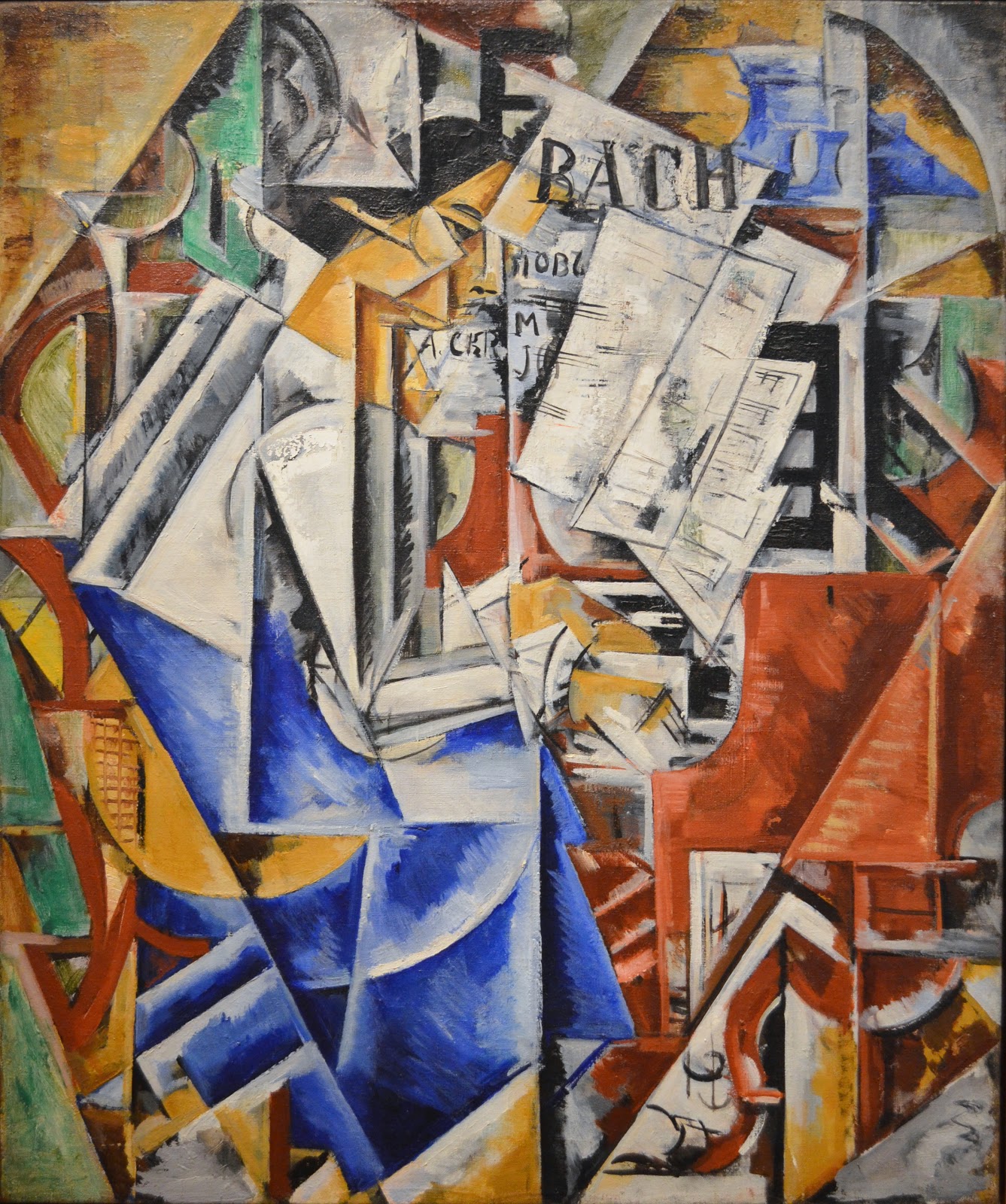
Image result for nadezhda udaltsova at the piano
Nadezhda Udaltsova
At the Piano


The two paintings above represent Modernistic art even though the styles might not look the same. Gabriele Munter practiced fauvism while Nadezhda Udaltsova practiced cubism. The text states "Reducing form to simplified color shapes bounded by dark contour lines, Munter synthesized the expressiveness of Fauve color with an ordered formal organization often based on pyramidal forms" (Chadwick 255), "The work of Tatlin, Exter, Popova, and Nadezhda Udaltsova, on the other hand, was more closely tied to cubism" (Chadwick 265). These different movements aided women in not confining them to a specific painting styles.
Fauvism experimented more with vibrant colors and cubism experimented with shapes, planes, and collages. Dadaism was a movement to ridicule the meaningless to the modern world. Surrealism was the movement of the creative potential of the unconscious mind. Expressionism expressed emotional experience. Constructivism was the movement that influenced many aspects of modern architecture and design.  Women were able to experiment when the painting styles that the were more comfortable with. They no longer painted religious figures or scenes, but they focused more on people, dreams, and symbolism.
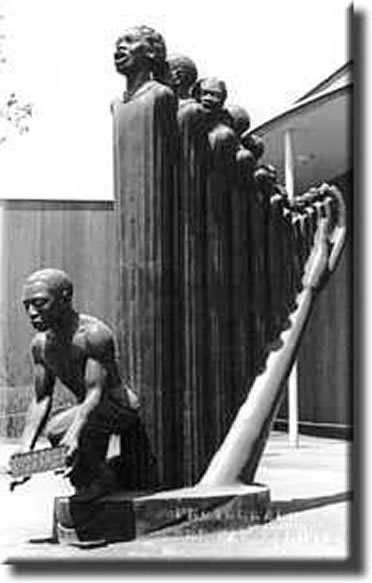
Image result for lift every voice and sing augusta savage meaning
Augusta Savage
Lift Every Voice and Sing
 Statements were made through art. Realism was oftentimes political. Realism focuses on real life and everyday settings. It was a movement where artists wanted to express themselves as things really were. For example, Augusta Savage in her sculpture Lift every Voice and Sing is a political piece. We can see that it's a harp made up of 12 black singers. Many may depict this during the times of slavery how slaves were chained together in one line but yet they still kept faith on being liberated.


  Postmodernism questioned the ideas and values of modernism. Modernism was focused on innovation and progression. Just like Modernism wanted to leave the principles of the past, postmodernism did the same to modernism. Postmodernism like modernism did not have a set style. Postmodernism was associated with pluralism and fragmentation. Postmodernism was open to everyone unlike modernism. Modernism was limited. Chadwick states "The fact that Postmodernism draws heavily on existing representations, rather than inventing new styles, and that it often derives its imagery from mass media or popular culture, has focused attention on the ways that sexual and cultural difference are produced and reinforced in these images" (Chadwick 380). Well known artists of this era were Cindy Sherman, Judy Baca, and Yoko Ono.
      Postmodernism began around the 1960s. Postmodernism is a body of art movement. In this period everything and anything is art. Anyone can create art and all of its forms are valid. Postmodernism was about the stories that weren't being told. The things that people were leaving in the dark and artists were shedding light upon them. As the realism movement, postmodernism was all about making statements. Postmodernism deviated from social constructs, for example men no longer dominated or surpassed women or homosexuals. Ana Mendieta used her body to create art and to send messages to the masses. Chadwick states "Working from a different cultural perspective, that of a displaced Cuban living in the United States, Ana Mendieta (1948-1985) first used blood in a 1973 performance protesting against rape. Mendieta's artistic roots lay in feminism and in the anti-commodification tendencies of earth, performance, and process work in the 1970s" (Chadwick 373). While some pieces sent messages, other post-modernistic art educated people. Annie Sprinkle in her piece A Public Cervix Announcement, invites her audience to take a look at her cervix. She does this to educate (mainly the males) about the female anatomy. After viewing her piece online, I was surprised because I never knew that the cervix looked like a circle with a dot. 
Image result for annie sprinkle a public cervix announcement
Annie Sprinkle
A Public Cervix Announcement

Image result for ana mendieta blood
Ana Mendieta
Untitled


 Many artists used themselves to promote their  own experiences. Cindy Sherman photographs herself to let the world know that she can reveal all the things that people are not addressing. In her piece Untitled Film Still #30, we can infer that this piece is about domestic abuse. Chadwick states "Cindy Sherman's photographs reveal the instability of gender, and challenge the idea that there might be an innate, unmediated female sexuality... In 1978, she began placing her own body in the conventions of advertising and film images of women. Many of them were drawn from the 1950s and 1960s; their use unable her to act out the psychoanalytic notion of femininity as a masquerade- that is, as a representation of the masculine desire to fix the women in a stable and stabilizing identity. Sherman's work denies this stability" (Chadwick 383). Postmodernism focuses on activism and politics. Today it is still a difficult concept because we don't where postmodernism ends. From periods behind many believed that art was the work of men but this eventually changed in postmodernism when anyone from anywhere created art and told their story or the stories that needed to be told. 

Image result for cindy sherman untitled film still #30
Cindy Sherman
Untitled Film Still #30


Links : https://americanart.si.edu/artist/augusta-savage-4269
http://theconversation.com/explainer-what-is-postmodernism-20791

Works Cited
The Guerrilla Girls' beside Companion to the History of Western Art. 1998.
Chadwick, Whitney. Women, Art, and Society: Fourth Edition. Thames & Hudson, 2007.

modernism/postmodernism


Nikki Ford
Art and Women


Modernism is based on the principles of formalism and independence. Another important characteristic of modernism is its disapproval to all traditional forms of art and culture. Generally, modernism is regarded as a kind of avant-garde, which encounters traditional culture. Initially it was considered as a force, which could oppose the dominant culture. Traditional examples of modernism in art. These studies correspond to all ideals declared by modernistic artists. Individualism and deep mission for inner self makes modernist authors turn to the depths of human conscious. The study of stream of realization, which is popular in Guerrilla girls and Chadwick. “The emergence of a self-conscious set of practices and characteristics through which the modern in art is understood developed gradually and coincided with the appearance of a first generation of women artists with more or less equal access to artistic training. However, the related notion of an “avant-garde” as the dominant ideology of artist as surely as did the guilds in the fifteenth century, and the academies in the seventeenth and eighteenth.” (Chadwick, p. 279)  Postmodernism in its turn appeared as a criticism of modernism. Art and culture are nothing but reflections of the life of the society. So, next turn in the development of the society gave birth to a new style in art and culture and postmodernism became this new style, which challenged modernism. There are several factors, which influenced the appearance and growth of modernism. Carol Duncan was a very creative artist that was a German Expressionist. Duncan wrote an essay about what the male perspective was about nude art. “Duncan’s essay points toward a long history in which the representation of the female body has been organized for male viewing pleasure. The subject of the nude in art brings together discourses of representation, morality, and female body as a site of male viewing pleasure, a commodified image of exchange, and a fetishized defense against the fear of castration has left little place for explorations of female subjectivity, knowledge, and experience.” (Chadwick, pp. 280-282) Women artists in Europe helped influence the techniques and development of Modernism. Women artist made an influential impact during modernism, particularly with fashion. Women artist began to including different colors, patterns and designs for clothing. Women artists in Europe influenced many movements, such as movements for abstraction, German Expressionism, Dada, and surrealism. “Dadaism is “an art movement that challenged every convention (except male supremacy) and scandalized society” (Girls, p. 66) the woman artist that created Dada was Hannah Hoch. Dada is to create a visual that isn’t really there, almost to shape the world in her eyes, the way she perceives life. “Returning to Paris in 1912, the Delaunays quickly became absorbed into the Dada milieu there.” (Chadwick, p. 270)
            For European society, the 18th century became the century of innovations and technical progress. During this period the very concept of relations between man and nature had changed and this naturally led to changes in the forms of art and culture. During the period of Enlightenment, separation between man and nature appeared and this duality was conveyed to many spheres of human life. The development of science made man a more independent creature and let him increase the understanding of human experience and natural forces. “By the first decade of the twentieth century, dandyism and Modernism had intersected in those men and women whose sexual lives also had a life in their art, and the cross-dressed figure of the woman artist had gained particular currency. At an historical moment when radical feminist were advocating “androgyny,” and designers like Coco Chanel were “masculinizing” women’s fashions, the “new look” also began to make its presence felt in the visual arts. In 1918, Alfred Stieglitz photographed Georgia O’Keeffe’s pale face and hooded eyes emerging from the inky darkness of a black bowler hate and high-necked coat. Sexual ambiguity also defined O’Keeffe’s modernity; like Brooks and her circle, the American painter has adopted a wardrobe of simple and elegantly tailored black-and-white costumes which she would wear for the rest of her life.” (Chadwick, p. 302) Valadon and Modersohn-Becker were two of the first women artists to express their art with the nude female form. This was considered a huge stepping stone for European women artist in this modern time. Sonia Delaunay helped make build abstract art. She was known for her bold use of patterns using color. “Delaunay’s work with textiles and embroidery encouraged her to break down forms and emphasize surface structure” (Chadwick, p. 261)  
Postmodernism is a kind of art that appeared in the middle of the 1980s. It’s difficult to define this concept because it is presented in architecture, sociology, art, music, film, technology and some other areas and it’s not always clear when postmodernism begins in this or that area. Defining and analyzing postmodernism starts from modernism because postmodernism originates exactly from it. Modernism appeared earlier and can be defined from two points of view. According to the first aspect modernism originates from the aesthetic movement of the twentieth century, the ideas of which are similar to Western ideas about art. The main characteristics of modernism are no difference between “high” and “low” kinds of art because every art is aimed to depict the reality. This also includes importance on inner feelings and the process of perception. For example, modernism presents human life and human subjectivity in fragments and as something tragic and mournful. The idea of fragmentation of the life prevails and this idea is depicted with sadness and grief. According to modernism, works of art can present the world in unity, while this unity is lost in the real life. In contrast, postmodernism depicts the idea of world fragmentation with enthusiasm and optimism, the world is meaningless and the art can do nothing to change this, the only thing that is left is to depict this world with irony and satire. Postmodernists define subjectivism of modernism literature as existential crisis and try to avoid it. Narrators deconstruct themselves and they do it consciously. Surrealism movement originated in the early ’20s and late 1910’s as a legendary movement that trailed with a new style of expression known as automatic writing, which pursued to release the unrestrained thoughts of the subconscious. The intellectual and illogical views of Surrealism indeed find their lineage in the clever and fanciful disregard for custom promoted by Dadaism years earlier.

Generally, Modernism is a movement in art, music, architecture, literature and technique in the United States and Europe in the 19th- 20th century, which appeared as a protest to the outdated esthetic culture. Modernism gave people a new way to contact with the reality and man became the master of this reality. Art became more personal and artists were in the center of attention. The last half of the 20th century is characterized by the failure of modernist propensities. This later led Modernism to be replaced by postmodernism. Postmodernism is characterized by the search of new forms to reflect the reality, deeper penetration in the inner world and replication of the inner thoughts and feelings of rejection. Any movement in literature, art or music is the reflection of social, economic and political sphere of the society and postmodernism is the reflection of our period.


Work cited

The Guerilla Girls, The Guerrilla Girls' Bedside Companion to the History of Western Art. Penguin Books, 2006.

Chadwick, Whitney. Women, Art, and Society. Langara College, 2016

https://www.google.com/search?safe=active&biw=1440&bih=820&tbm=isch&sa=1&ei=AyWuXMKVMo-zggeI2aqoBg&q=sonia+delaunay%2C+couverture+1911&oq=sonia+delaunay%2C+couverture+1911&gs_l=img.3...330416.340407..340543...0.0..0.223.2368.33j1j1......1....1..gws-wiz-img.......35i39j0j0i8i30j0i30j0i5i30j0i24j0i19.0sosu5vx_84#imgrc=XhxZHNeaSo2bFM:


Tuesday, April 9, 2019

Modernism & Postmodernism

Nama Ebraheem


Modernism was a global movement in the late 19th and early 20th centuries. It influenced men and women who lived in Europe. Artists all over the world used new techniques and imagery to create art that reflected the current modern society. This movement included many “isms”. “Some wanted to change the world, others just wanted to change the art. In Western art, movements and “isms” appeared, one after another: impressionism, postimpressionism, fauvism, cubism, futurism, constructivism, dada-ism, surrealism, expressionism, abstract expressionism, etc. Put them all together and what do we get? Modernism” (Guerilla Girls, 59). These styles of art created a movement for artists and allowed women to have the same freedom as men. Moreover, it gave women more rights in terms of work related to art. On one hand, their social position has changed drastically compared to the middle ages. For instances, women were allowed the right to vote in the 20th century. It was a huge accomplishment and confidence booster for all women around the United States. On the other hand, women still received a lot of discrimination. Also, it was believed that the male artist’s work was still better. Women were still expected to stay home and serve their husband and children.

Women artists in Europe helped influence the techniques and development of Modernism. They made a huge impact during modernism, especially with fashion. They started including different colors, patterns and abstract designs in designing clothes. Further, women artists in Europe influenced many movements such as movements of abstraction, German Expressionism, Dada, and surrealism. For instance, the abstraction is a type of art that doesn't have to be mainly focused and is usually created by different colors, shapes, and textures. It can be viewed in quilts, curtains, dresses, and other objects used around the house. Sonia Delaunay helped make build abstract art. She was known for her bold use of patterns using color. “Delaunay’s work with textiles and embroidery encouraged her to break down forms and emphasize surface structure” (Chadwick, 261). She was an influential skilled artist during her time. In this painting, she used the colors of black, white, and gray to signify the world.
Sonia Delaunay, Couverture de Berceau, 1911
“Their patterns of abstract forms were arranged both to enhance the natural movement of the body and to establish a shimmering movement of color” (Chadwick 262). That allowed women to show their talent and demolish the societal expectations of them. German Expressionism and Dada were other types of art. German expressionism is an artwork that tells a story in a way related to social or political aspects. However, Dadaism is “an art movement that challenged every convention (except male supremacy) and scandalized society” (Guerrilla Girls 66). Dadaism is a way of showing the reality that wasn’t meant to be seen. It uses shapes to portray the modern world. The art displays emotions so it is mostly dull. Hannah Hoch is a big named dada artist and her most famous piece is called Marlene.
Hannah Hoch, Marlene 1930

Surrealism was another movement in the 1900s which allowed artists to express their ideas within the unconscious mind. Many female artists during this time decided to make use of female figures illustrating that the female body was not always dominated by the male gaze. They were able to be in charge of the image they wanted women to have. Louise Bourgeois was a strong influence in the surrealist movement. Her drawing usually displayed the body of a female and showed how the woman had no voice during the time. While Frida Kahlo produced work with Surrealism characteristics but she was painting her reality. Her art expressed an emotion, event or her personal feelings. The Broken Column shows all the pain and suffering she went through but she is still standing strong.
Frida Kahlo, The Broken Column 1944


Postmodernism developed after world war two. World War two signified the beginning of technological advancement which influenced art. Postmodernism and modernism consist of some similar ideas though they’re still considered to be opposite forms of art. For example, Modernism focused more on unrealistic abstract ideas while postmodernism is about reality and the actual experiences of those expressing their artwork. While modernism focused on finding an answer, postmodernism questioned it. “Postmodernism was known as the breaking down of the unified traditions of Modernism”, "Postmodernism draws heavily on existing representations rather than inventing new styles, and it often derives its imagery from mass media or popular culture, has focused attention on the ways that sexual and cultural difference are produced and reinforced in these images."(Chadwick 380). Essentially, postmodernism is about pluralism and inclusion of all people and art forms. Art expanded to include many different forms. Therefore, this called for diversity and contradiction.

Feminist viewpoints played a huge role in Postmodernism. Artists often used their own bodies as canvases to deliver their messages across to the audience. Such as Hannah Wilke who made the video “Gestures” to portray how facial expressions can be perceived in many different ways. It also demonstrated that the female body does not need to be framed to be stereotyped by men.
Hannah Wilke, Gesture 1974
Also, Yoko Ono and her famous performance artwork called “Cut Piece”. She gave herself to the audience and allowed them to cut her clothing off. It demonstrated that the audience lacked the consideration of the artist's or any female body.
Yoko Ono, Cut Piece 1964
Barbara Kruger was another artist in postmodernism who further depicted this by “emphasizing the ways in which language manipulates and undermines the assumption of masculine control over language and viewing, by refusing to complete the cycle of meaning, and by shifting pronouns in order to expose the positioning of woman as other" (Chadwick 382). Her works mostly challenge viewers to question the culture, social, and societal.
Barbara Kruger, your body is battleground 1989
Overall, Modernism and Postmodernism both had a common push for feminism. They both were time periods that included heavy women involvement. Also, postmodernism expression was used to demolish the male superiority that was held with art in the past.


Works Cited

The Guerilla Girls, The Guerrilla Girls' Bedside Companion to the History of Western Art. Penguin Books, 2006.

Chadwick, Whitney. Women, Art, and Society. Langara College, 2016

Fouzia Hussain
Modernism vs. Postmodernism
Professor Cacoilo
6 April 2019
Modernism Art vs. Postmodernism Art
There is a difference between Modernism Art and Postmodernism Art. They both happened in two different times that explains how people portrayed and started art. To begin with, modernism happened during the 1860s and 1970s were people made art based on the events that were happening during that time. Artists would use the experiences they have dealt with, examples are like when women artists painted their feelings on their art, such as the equal rights they want alongside with men, how women are treated as “objects”, and etc. In contrast, postmodernism is why that artwork was made. This is when it turns political or racial and trying to send the audience a message or trying to have people understand why this was made.
In modernism, there were different movements that were going on. In chapter 10, it stated, “Carol Duncan traces the sexualizing of creativity in the work of the Fauves, the Cubists, and the German Expressionists, and she argues that the vanguard myth of individual artistic freedom is built on sexual and social inequalities” (Chadwick 280). This ties into how females felt on the inequalities they got as well as sexuality. As a German expressionist, there was a female artist named Paula Modersohn Becker who made a self-portrait.
Modersohn made this nude painting to show “female identity” and how this women feels showing expression by emotions. This is to show or tell the audience how she feels is viewed as a feminine.
This painting was by Kathe Kollwitz, named “Attack”, The Weavers Revolt. This painting was shown to describe the tragedy she faced after losing her son in the war and her grandson in the second (Chadwick). This was German expressionism that was refused to be shown because people did not want to show “social reality”. She explains that there's a difference between who makes the painting as well as who was in the painting that dealt with the tragedy itself. Basically stating how there's two different viewpoints for people.
Similarly to this art was Suzanne Valadon, who made nude paintings and had critics that have gone against it, but she still expressed this to show the power behind females. It stated, “Instead of presenting the female body as a lush surface isolated and controlled by the male gaze, she emphasizes the awkward gestures of figures appear in control of their own movements” (Chadwick 285). This is when she uses her art to explain the movements that were happening and how male or men viewed women for their pleasure. Fauvism soon started as a movement where artists used “unnatural colors” to show more emotion in their paintings. Moreover, cubism is another movement that happened expressing reality by putting different objects in figures of their painting. An artist named Alexandra Exter was part of this movement. In the Guerilla Girls, it stated, “Back in Russia she became a cheerleader for modernism, getting to know artists all over and organizing shows of new art” (Guerilla 64). Exter encouraged other artists including females for her movement. When it mentions here how she advocated other artists, she advocated the cubist movement that was happening as well.

The link provided down below explains at least 7 things about this movement.

She would An example of a female artist is Frida Kahlo that was part of the Cubist movement.
Frida Kahlo- The Broken Column; part of the Cubist movement. This painting is showing pain (as shown under her eyes; the tears that are falling), the image that is showing inside her body is when she got into a bus accident and an iron handrail went through her body, this painting is describing and showing imagery of what happened. This accident had injured her so much, the painting defines it all.
Furthermore, postmodernism talks about why the artwork was made. In the text, it stated, “Despite such achievements, women of color often faced formidable political and social barriers” (Chadwick 317). Postmodernism uses how modernism was but more towards their artwork, using like media as a challenge towards their art. An example of a female artist that used postmodernism as an example is Faith Ringgold Die.
-This link explains in further detail towards race and the meaning behind this painting of how protest was part of a movement during the postmodernist time. This was fighting for equal rights.

This painting is made by Faith Ringgold Die. This painting is explaining the protest riot that is happening during that time. This is describing the backlash and differences between white and black people. This is expressing hate in society, with the blood representing and the people laying dead or flying. Ringgold talked about her experience in Harlem and how the march in Washington happened.
The movements that happened in postmodernism was activists fighting for justice, especially women. They have made males understood what they deal with as a female. In the text, it stated how the women movement made a huge impact on women and being an eye opener to at least some males. “The women’s movement profoundly affected me; it led me, and all the people around me, to see things more clearly. I don't think before that I was aware of the roles women played… There is always a woman in my work, and her role is questioned” (Chadwick 345). This movement had male and audiences realize what women deal with, their perspective upon it. Moreover, abstract art was very popular during this time as well to express paintings.

Joan Snyder, the artist of this painting is describing abstractionism. In this painting, it's showing the different materials used/shown. The differences in brushstrokes based on the picture and the resemblance on the tears that are shown and the blood gushing down. This is showing a theme such as in a political way (Chadwick).
Women used different ways to explain what happens in the world in a historical way even. Such as how women like Stuart used rocks in her painting to describe her upbringing in Southern California. As Chadwick mentioned, artists use sculpture to describe the problems that are occurring in Earth as a way to tell the audience what is happening in the world. Postmodernism is again explaining why the work is made, so in this case, she made this sculptor to reflect and explain her experience in South Carolina and the layers that were there.
   In all, modernism started off first showing the experiences people have dealt with and postmodernism occurred after that. Modernism was about how women have dealt with experiences and postmodernism is explaining why and targets more of an audience or to people to understand why or what is going on in the world.
Link:
This link provided explains and lays out the differences between modernism and postmodernism art. The characteristics as well as how science is involved along with them.