Thursday, February 7, 2019

Male Gaze and Patriarchy


The male gaze was developed by Laura Mulvey who was a feminist film critic. Mulvey published her essay “Visual Pleasure and Narrative Cinema” in 1975. She defined the male gaze as the perspective of the world and women from a man's point of view. The male gaze is the way men objectify women and treat them like they are something they own. “One might simplify this by saying: men act and women appear. Men look at women. Women watch themselves being looked at … Thus she turns herself into an object - and most particularly an object of vision: a sight” (Berger 47). In society, the male gaze is when a man looks at a woman to find them desirable, and women should feel flattered if a male finds them attractive. “She has to survey everything she is and everything she does because how she appears to others, and ultimately how she appears to men, is of crucial importance for what is normally thought of as the success of her life” (Berger 46). It shows how women have to be worthy of a man’s attention since it is a woman's job to please men. If a woman is attractive in a man’s eyes, they are successful in life because the man will take care of her.
The male gaze is still problematic in today’s society because it oppresses women to feel worthless and makes them feel as if their duty is to entertain men. “Women are there to feed an appetite, not to have any of their own” (Berger 55), so they can not do what they want but instead do what their husband wants. Other problems the male gaze gives to women in society is catcalling, which is when men will talk or yell at women to prove that they have control over them and to show their superiority and power over them. Other examples of the male gaze are shown in films and magazines, but some people do not even see or recognize it. Since the male gaze is everywhere and it is so common, people tend not to say anything about it or not even notice that it is there.
Mulvey also discusses the female gaze in her essay, which is when women look at themselves and other women from a man's point of view. To use the female gaze, women would have to use society’s norms and inequalities that a man would use for the male gaze. The female gaze could be used by women to putting themselves in a man's shoes to see the man’s perspective of the world and women.


Le Déjeuner Sur l’herbe
Painted by Claude Monet and Édouard Manet, 1862
The painting shows a picnic with a woman nude, another woman barely dressed and two men fully dressed. There are three types of male gazes which are the male gaze of the person who made the artwork, the male gaze of the people in the artwork, and the male gaze of the viewer of the artwork. Le Déjeuner Sur l’herbe represents the male gaze by having the nude woman looking at the spectator of the painting to please the male viewer. Having the women nude show how she is trying to impress the viewer to find her attractive and desirable. Compared to the women’s body language depicted in the painting, the two men’s body language shows their power and authority over the women.

Image result for magazine covers

Picture of Zooey Deschanel on the cover of Cosmopolitan

She shows how the male gaze is applied and shown in media and advertising like magazines. Deschanel looking directly at the spectator of the picture shows how women look at the viewer to please them.

“Patriarchy is a political-social system that insists that males are inherently dominating, superior to everything and everyone deemed weak, especially females, and endowed with the right to dominate and rule over the weak and to maintain that dominance through various forms of psychological terrorism and violence” (Hooks 18). Patriarchy is the system or monarchy of who holds the power in society, which are men. Patriarchy is when society puts more value in men than in women, which gives more privileges to men. Male dominance is shown in situations like a family where the father is the head of the household and brings in the income for his family, while the mother is the caregiver and has to depend on the husband to take care of everyone in the family financially. Patriarchy is sexist to family roles because it depicts a wife as the “caretaker” and the husband as the “breadwinner”. Just because of a women’s sex, they are looked at a certain way in society and they are expected to have certain gender roles and family roles that they have to follow. The family roles devalue the women’s roles and show how the man’s roles are superior. Patriarchy oppresses women so that she can make herself little to make her husband feel big and in control. It oppresses the women to not do what she loves or wants because she has to put her husband’s needs before her own.
“Of these systems the one that we all learn the most about growing up is the system of patriarchy, even if we never know the word, because patriarchal gender roles are assigned to us as children and we are given continual guidance about the ways we can best fulfill these roles” (Hooks 17-18). Patriarchy is taught to children from a young age like what a boy and girl should or should not do and act like. From there, girls and boys are expected to follow these guidelines until they are adults. Growing up, I was taught the female gender roles and when I disobeyed them, my parents would tell me not to do that. My family taught me what was the right and wrong behaviors for women in society. Still, patriarchy is used with families giving their son more power than their daughter just because they are a boy and boys have the capability to protect themselves and be stronger. Most of society is still traditional, so they continue to follow the “norms” of family roles and gender roles. When people do not follow the “norm”, others will judges and harass them for not following the traditions that people are used to. Same goes to gender roles if men are not masculine and females are not feminine, they are shamed for going out of the “norm”. We have to start changing the gender roles and family roles now so that patriarchy would have less power upon our lives.
Both patriarchy and the male gaze discuss the dominance and control men have on women in society. Patriarchy and the male gaze changed my views about art and media because they opened my perspective on how there is sex discrimination everywhere that I have never noticed before. In the future, I can be more aware of what is shown in things like advertisements and know that it shows the concepts of patriarchy and the male gaze. As a society, we should push away the male gaze and patriarchy and treat everyone with respect and equality.

Work Cited
Berger, John. Ways of Seeing; a Book Made by John Berger. Viking Press, 1973.

Borman. “What Is the ‘Male Gaze’?” Mary Janes Film, Mary Janes Film, 20 Feb. 2018, maryjanesfilm.com/what-is-the-male-gaze/.

Hooks, Bell. Understanding Patriarchy. Louisville Anarchist Federation Federation, 2010.


To formally define the male gaze, we can turn to the book Ways of Seeing by John Berger. This book by Berger takes a feminist standpoint and describes how men view women and how this can ultimately lead to the oppression and objectification of a woman. Regarding the male gaze, he says, “And so she comes to consider the surveyor and the surveyed within her as the two constituent yet always distinct elements of her identity as a woman. She has to survey everything she is and everything she does because how she appears to others, and ultimately how she appears to men, is of crucial importance for what is normally thought of as the success of her life. Her own sense of being in herself is supplanted by a sense of being appreciated as herself by another” (Berger 46). The way straight men view women as sexual objects that are present for their own pleasure, then affects how a woman views herself.

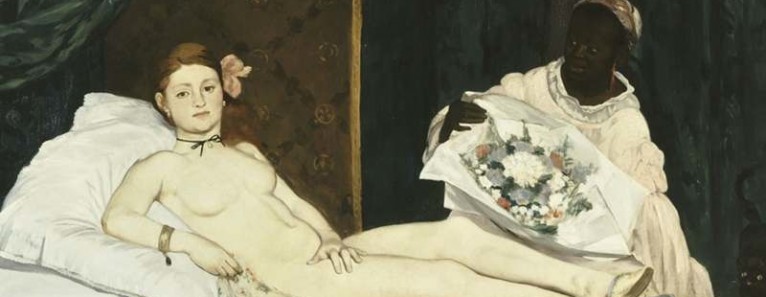
Figure 1: Olympia 1863 by Edoardo Manet

This painting for example is of a woman who is suspected to be a prostitute. There are many factors in this painting which give the woman power, the way her gaze is serious and unwavering, the cat that symbolizes femininity, the flowers sent by a past lover which she is ignoring. At the same time, this picture also takes away the power of the woman and gives it to the viewer who is asserting the male gaze. The woman is posing a certain way and she is naked for the pleasure of the male viewer, she tries to hide her nakedness while consequently drawing attention to it at the same time, she has a lack of body hair. These factors all contribute to the male gaze as the woman is focused on how she is being viewed by the man. Of course, many examples of artwork following this same concept are in existence because art has been such a male dominated field for so long and set a certain precedent from its beginnings.

A parallel to this would be the female gaze which focuses on women but doesn’t necessarily sexualize them. Works done by females give more power to the subject and the female viewer. These types of woks are beneficial to women, but to a certain extent because they are often non-inclusive towards those of color and of certain sexuality. To combat this is the oppositional gaze which is focused on those of color. To revert to the painting Olympia by Manet, the second gaze in this painting can also be directed at the maid in the background who is a woman of color and almost seems as if she is disappearing into the background like she is irrelevant. The oppositional gaze works against artwork like this and appears empowering to those groups who are marginalized such as women, people of color, and is just appealing to many groups overall who can appreciate artwork outside of popular culture, not just those who are marginalized. Another example to refer to would be the recent movie Get Out by Jordan Peele. This movie features characters who are white and non-white peoples and depicts a metaphorical and literal story about the fight against white supremacy and white privilege.

The idea of the male gaze goes hand in hand with patriarchy. As described in her article Understanding Patriarchy by Bell Hooks, she defines patriarchy as, “a political-social system that insists that males are inherently dominating, superior to everything and everyone deemed weak, especially females, and endowed with the right to dominate and rule over the weak and to maintain that dominance through various forms of psychological terrorism and violence” (Hooks). Patriarchy is systemic in the way that it is passed down through generations. Parents follow this sort of system because it is what has become normal and deemed as socially acceptable after so many years. Men are not the only ones who enforce patriarchy either, females carry the torch to patriarchy as well because its what makes sense to them as they were probably raised through a patriarchal home as well. Patriarchy also not only creates a problem for women, who must be undermined and oppressed by it, but for men as well. Men must act a certain way and if they don’t, they are seen as too feminine or as “gay” (which is termed as an insult by patriarchy when it shouldn’t be). Patriarchy is a system that is poisonous to those of all genders and sexualities, but it is hard to just abolish because it is a backbone of popular culture.

Take The Little Mermaid for example, a movie that is supposed to be an innocent Disney movie has a deep patriarchal message behind it. Ariel the main character has a beautiful voice, but her voice gets taken away and can only be bestowed back onto her if she can make a man fall in love with her by using her beauty and charm (while being a mute). What could signify patriarchy more than that? This movie simply put is showing exactly how patriarchy affects women as the male in this movie has all the power over the female, and whatever his ultimate decision is regarding her, is the outcome.

Figure 2: The Little Mermaid (1989) by Ron Clements 


Links:

https://blackboard.rutgers.edu/webapps/blackboard/execute/content/file?cmd=view&content_id=_1867402_1&course_id=_110320_1


Male Gaze and Patriarchy


A woman admiring herself in the mirror wearing lingerie and heels.  


The Male Gaze is a process, a social construct if you will, by which heterosexual males view given surveyed objects; specifically, female objects.  In “Ways of Seeing” John Berger explains how both genders perpetuate the idea of this gaze:  “men act and women appear” (Berger, 47).   Bergen goes on to explain how this perception actuates the way women are represented by themselves, of themselves and to others.   Berger also believes that society has groomed women for this role; “To be born a woman has been to be born, within an allotted and confined space, into the keeping of men” (Berger, 46).  Moreover, he also suggests that men are groomed as agents of taking.  "A man's presence suggests what he is capable of doing to you or for you...By contrast, a woman's presence expresses her own attitude to herself, and defines what can and cannot be done to her."  (Berger, 46)  A man's  presence is one of power and control.  However, his counterparts are seen as objects of a natural sexualized nature, there for his taking.  Men are there to look.  Women are there to be looked at.  Women are there to be taken by the likings of a man.


Helen Fourment in a Fur Coat
1630 By Rubens

The Male Gaze & Patriarchy

Male patriarchy is feeling nervous when walking alone at night as a woman. Male patriarchy is assessing every man near her as a threat. Male patriarchy is not having a single female president of the United States. Male patriarchy has different ways of manifesting itself in society; most importantly, male patriarchy is that implicit oppression of women just because they are women. However, we must not forget that male patriarchy is not only the oppression of women, but it is also the way in which young boys become vulnerable to preconceptions of masculinity. Starting in the home, boys learn to reclaim their identities with their fathers, being the main teacher of oppression. In Bell Hooks’ book, The Will To Change, she observes firsthand how differently she was treated as a young girl compared to her brother. She was taught that being a girl meant “to be weak, to be free from the burden of thinking, to caretake and nurture others” (Hooks, 18) while her brother was taught to be the opposite. According to Hooks, patriarchy is “a political-social system that insists that males are inherently dominating, superior to everything and everyone deemed weak, especially females” (Hooks, 18) We see patriarchy in our society manifesting in homes, in the streets, in the workplace, and in popular culture. Even more, the ideas and assumptions that structure this form of patriarchy all root from the ideas that it is white, middle-aged, middle-class men who have this specific kind of power. Because of this, expressions of racism and sexism are revealed in society. Let’s take popular culture for example. Have you ever seen a man being advertised sexually in order to sell a product? Maybe you have, but probably not as much as you have seen women being sexualized in advertisements. 
Pamela Anderson for PETA. This advertisement shows a captured image of model Pamela Anderson, trying to encourage people to go vegetarian, showing that animals have the same parts are humans.
(https://www.peta.org/features/pamela-anderson-shows-animals-same-parts/)
Do we need to have a female dressed in a bikini, being photographed sexually, to show that animals have the same parts as humans? It's ironic that while PETA tries to promote vegetarianism in order to fight against animal cruelty, they are dehumanizing a human being at the same time. So which one is it, PETA? 

Because we have patriarchy that rules our society, we also have the male gaze. The male gaze is a man's perspective on the woman. In John Berger's Ways of Seeing, he simplifies the male gaze as the idea that "men act and women appear" (Berger, 47) Women become the objects for the man to admire and judge. Berger includes a painting in his book, The Judgement of Paris, seen below. 
The Judgement of Paris, 1577-1640
This image depicts Paris judging different women, and whoever he found most beautiful received an apple.  "Those who are not judged beautiful are not beautiful. Those who are, are given the prize. The prize is to be owned by a judge--that is to say be available for him" (Berger, 52)
The simple fact that the man decides for a woman when she is available to him is the same ways in which many women can relate to the catcalls and male gazing that she experiences in the streets. Unfortunately, as men seem to think women owe themselves to them during this Renaissance period, many men still feel as though they have a right to a woman's body today. The Judgement of Paris was created during 1577-1640 by Peter Paul Rubens. Let's fast forward to 1975, where an ad for some sort of construction equipment came out:
Construction News advertisement. London, England.
(http://msmagazine.com/blog/2010/05/21/from-the-stacks-heavy-where-she-has-to-take-the-strain/)
"She's built like all our products ... Heavy where she has to take the strain"  
Although we do not see it as clearly as we see the male gaze in The Judgement of Paris, this particular advertisement was geared obviously towards men. The woman is compared to a construction tool and her body is seen as a commodity. She is clearly turned around, her face not visible to the audience because it seems that nothing else matters than her body. This advertisement was meant to appeal towards men, all while desensitizing themselves to these sexual images of women clearly being exploited. How is a woman built like a product? And why are men never subjected to these kind of insensitive adverts? Because our society is built on patriarchy and patriarchy is dominance of men over women. 


Works Cited

Berger, John. Ways of Seeing: Based on the BBC Television Series with John Berger. British Broadcasting Corp., 2012.

Hooks, Bell, 1952-. The Will to Change : Men, Masculinity, and Love. New York :Atria Books, 2004. Print.

Male Gaze and Patriarchy

Biki Aly
Art and Women
Professor Caçoilo

The male look is the demonstration of portraying ladies and the world, in the visual expressions and in writing, from a manly, hetero viewpoint that presents and speaks to ladies as sexual articles for the joy of the male watcher. The male gaze was coined by feminist Laura Mulvey in 1975. In other words the male gaze explains the idea that when a women is in a art piece  they are are used as a satisfaction for the male watcher. This allocation started during the renaissance period and till this day is still going on. The Male Gaze is influential in craftsmanship and pop culture since it is to a great extent a coherent response to why ladies photo the manner in which they do and why they were painted a specific way. In John Berger’s reading “Ways of Seeing”, he says A woman must continually watch herself. She is almost continually accompanied by her own image of herself” (16). By saying this, it shows that while a woman is being looked at she unconsciously is thinking about how she looks to the person who is looking at her. Down below shows a picture from the Daily Art Magazine that was published by Alina Manevskaya which shows an example of this matter.

In the reading of Bell Hooks “Understanding Patriarchy” he says, "Patriarchy is a political system that insists that males are inherently domineering, superior to everything and everyone deemed weak, especially females, and endowed with the right to dominate and rule over the weak and to maintain that dominance through various forms of psychological terrorism and violence"(Hooks 18). By this, he is saying that patriarchy can be a very valid reason as to why the male gaze is still happening till today.
Sexism can be an example of the male gaze. Society has the idea that men need to be dominant and strong at all times. When men engage in an act of sexism it makes them feel like they are dominant. An example of this is, in the movie “Fifty Shades of Grey” one of the main characters, Christian Grey is an example of patriarchy because he has this sexual abusive relationship with the second main character Anastasia. In the movie Christian gives Anastasia these paper that list all these sexual things that he can do to her whenever he wants to. In other words Christian is the dominant character and Anastasia is the submissive character which means Christian can do anything he wants to her. In the photo below it will show you how Anastasia is blindfolded having no idea what is going to be done next while Christian who is dominant is behind her taking control. Another example is one of my own personal examples. Growing up in an Egyption family household my family was very strict on me and all my girl cousins. My male cousins were only 5-6 years older than me. When I ask to go out the following statement after that is that I have to be home by 10pm and while I am out my parents call me 3-4 times just to check up on me. On the other hand when my male cousins go out they do not have to be home by a certain time and they don’t have to be checked up on.
After talking about the male gaze and patriarchy in class and looking more into it it really showed me how much they actually happen. Now a days a lot of men look at women for not who they are but more of how their body is shaped. This is an embarrassment for society because a woman who has a good body is not what it is all about.


The patriarchal power to gaze

“Men survey women before treating them.” This is significant because a woman’s worth is directly related to how she is viewed by the men around her. This puts a disproportionate and unfair amount of pressure on women to ensure that they are portraying the most ideal image of themselves to whoever is around. According to John Berger, male gaze is when a woman is depicted in a sexual manner done for the pleasure of a male audience. This takes away any idea or notion of how a woman views herself by making her focus on the way that men view her. In the text we see a plethora of nude women painted for the viewing pleasure of an audience which in this case would most likely be a man. One thing that these paintings share in common is that each female subject is aware that she is being watched and even joins us in looking at herself. In one of the pictures, Susannah  is taking her bath, she is being spied by the Elders and us while looking back at us looking at her. In another version, she is looking at herself in a mirror, thereby joining the audience in spectating herself. These two images show that women have to be aware of the way they look since they know that is how they will be judged. This also helps paint women as vain by showing them to be always aware of their looks. In a patriarchal society, male gaze has a prevalent position due to men being in control and making decisions that helps them remain in power. Women in such a society will always be viewed as an object so placing them in art mediums will be for the benefit of men. When companies advertise a product that is aimed at men, there always seems to be a desirable woman present suggesting that if you acquire said product you will have a beautiful woman like that. We can see this with a car commercial that depicts a man picking up his ‘hot’ girlfriend who seems disinterested about the world around her but is well aware of the fact that the man and the audience at large is admiring her. She then becomes something that can be attained by losing any semblance of self identity.  With the ever growing presence of social media, women now have to be aware of how they appear on their personal pages. When uploading a picture, she has to be aware of the kind of suggestions that the image is making. This is due to the fact that men are going to be the ones surveying and commenting on the pictures and knowing this, a woman would have to be careful only to put out art that provides a view that is beneficial to the way that men treat her. The image of the woman below working on the car is hyper-sexualized for the benefit of the audience which judging by her in the hood of a car, is a medium targeted at men. In contrast, oppositional gaze takes a look at black women as being media spectators. This is developed due to black people's rights to gaze being repressed. The more this is attempted, the greater the desire to gaze is. This gaze is important because it teaches blacks to look to show resistance or oppose being confined to the status of the surveyed.


According to Bell Hooks, patriarchy is “the single most life-threatening social disease assaulting the male body and spirit in our nation.” (Hooks 17). What is meant by this is that most men are no aware of what this word means and how it pertains to them and those who have heard about it, view it as a weapon feminist use to attack men. This is fitting since in a male dominated society, the men do not need to be aware or well versed in  a topic that is not negatively impacting them. We see patriarchy assert itself in the way that men carry themselves as a powerful dominant force that leads the household, heads places of employment and even demands that the male bloodline determine identity of children through surname and in some cultures by disregarding a mother’s bloodline and placing the child in the father’s family tree. Patriarchy is not only detrimental to women but is dangerous to those its design to help keep privileged. “Patriarchy demands of men that they become and remain emotional cripples. Since it is a system that denies men full access to their freedom of will, it is difficult for any man of any class to rebel against patriarchy,...” (Hooks 27). Through patriarchy males are not allowed to pursue interest of their that might be considered feminine. There is this pressure lingering that forces young boys to do things that a man would do regardless of whether he is interested in it. I for example have always loved the color pink, but have refrained from enjoying the color due to being teased by boys my age who viewed it as a girls color. This even creeps up into adulthood in emotional situations because men were not taught how to properly process their feelings or were shamed by expressing it, leaving them no choice but to bottle it up and have it all erupt in spurts of violence and anger. Although most men do not actively promote patriarchy, however they do succumb to a lot of its expectations thereby helping push its agenda over women and society at large. The image below shows ways that women are being silenced when they speak up about their negative experience due to male aggression. The victims are essentially blamed by suggesting that they brought the situation upon themselves due to the way they carried themselves or a lack of effort in exiting the situation. This does nothing but protect the powerful male figure.


Works Cited
Berger, John. Ways of Seeing. London: British Broadcasting Corporation and Penguin Books. 1972. Print.
Hooks, Bell. "Understanding Patriarchy." The Will to Change. Atria Books: 2004

Male Gaze and Patriarchy


Rahmeh Abdulaal 


Ever looked at media ads that pop up randomly most of the time, either while watching a video on Youtube, or a show on TV. looking at these ads, most of them are "women portrait" ads, meaning they are there for men's pleasures, to please their inner self with these ads. For example, an ad of a perfume bottle, almost all perfume ads have half-naked women that turn and twist the idea of smelling a certain way as that bottle/brand portrays into a more of a sexualizing act that would attract one's eye more. Below is a picture that uses women as the cover of a perfume ad, from the first glance the first thing a person sees is the women and the way she is posing and looking. Therefore, sexualizing the ad, it is more of an attraction and grabbing a person's eye, then it is about the perfume, and the only way to attract a person's eye and attention is through the use of women since they solely assume that mostly men are seeing it.
The 2013 "Rogue" by Rihanna is a perfume ad that uses a specific women model as the main focus, for the reason of attraction and proving the idea of the male gaze.

This idea of using women in platforms to attract a certain crowd is called "Male Gaze". English writer and art critic, John Burger explains his own definition of the male gaze in his article saying "To be born a woman has been born to be born within an allotted and confined space, into the keeping of men" he continues "The surveyor of women in herself is male the surveyed female. Thus she turns herself into an object and most particularly an object of vision: a sight"(Burger, 46). In simpler words, Burger explains that the male gaze is the idea or act of using women as objects, hence him mentioning "a sight", meaning they are only to be looked at, women are drawn and used in the art for the purpose of men's sight. Throughout John Burger's piece, he gives the reader multiple pictures and goes into details about the importance of each pose and what each part of the women's body symbolizes. Looking back at today, interpreting this idea to our modern day art would be sexualizing women on all forms of social platforms, such as TV shows, movies, magazines, and etc, the ideology of the male gaze still exists in all cultures and platforms just in a more less prominent way. Which we constantly see throughout all forms of communication, not only social media platforms but also posters on the walls that are located in different stores or some even on the streets. Glancing back at the European nude paintings during the 15th century, these pictures were mostly used for men's pleasure, since back then women had no legal rights but to be owned by a man. The women in most of the painting were looking back at themselves. John Burger explains this idea saying "he is the spectator in front of the picture and he is presumed to be a man" (p.54). Reflecting back at the paintings in John Burger's article, looking gave men power, same applies to today's ads and social media in general. Nonetheless, The idea of the male gaze is very manipulative and persuasive and still exists until now, even though it's been going on since Greece or even before.

Looking back at John Burger's time period, we see that the male gaze came about from the idea of "Patriarchy". According to the English writer Bell Hooks, Patriarchy is " A political social system that insists that males are inherently dominating, superior to everything and everyone deemed weak, especially females, and endowed with the right to dominate and rule over the weak and to maintain that dominance through various forms of psychological terrorism and violence" (Hooks, 18). Throughout Hooks piece, we see the struggle that she went through with her own family and society members, where men were in control and she could not be as free as she wanted to be. However, this did not only affect her as a female member but looking deeply we see that this ideology affected males as well. For example, her brother clearly was not as 'male-like' as he should be, which was frowned upon, he had to become someone he was not comfortable with, which affected him in a certain way. Hooks explains this saying "I was always more interested in challenging patriarchy than my brother was because it was a system that was always leaving me out of things that I wanted to be part of "(Hooks,20). Looking back at the time of Bell Hook to our time period now, we still see patriarchy everywhere, whether it is in the social system, political system, or cultural system. Relating this back to my personal life, I grew up in an Arab household, where most of the time women were treated a little less privileged than men. Thankfully, my parents are understanding and never showed this type of discrimination, even though many assume that it exists, however, I have seen it first hand with my extended family. Where my cousins were not allowed to leave the house at all, either with their brother or father by their side, until they got married. This personal example proved that patriarchy still exists, and it is a very harsh system that people like to deny that it does exist.


Works Cited

Berger, John. Ways of Seeing. London: British Broadcasting Corporation and Penguin Books. 1972. Print.

Hooks, Bell. Understanding Patriarchy. Louisville Anarchist Federation Federation, 2010.

Rihanna's Rogue Perfume advertisement. https://www.thefashionspot.com/runway-news/413891-14-other fashion-beauty-ads-that-were-banned-in-the-uk-besides-rihannas-perfume-ad/#/slide/1

The Male Gaze and the Oppositional Gaze by Hanan Abdel-Hamid. http://artandwomenfa2012.blogspot.com/2012/09/the-male-gaze-and-oppositional-gaze.html