Monday, January 28, 2019

Mini Post: Barbara Kruger

           BARBARA KRUGER 


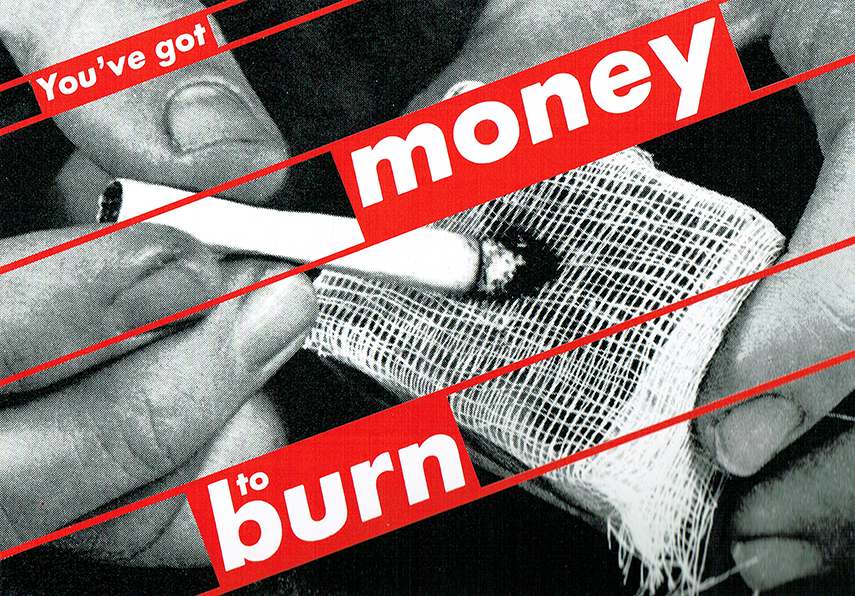
                                              Barbara Kruger untitled museum - You've Got Money to Burn,1987 untitled american - image via nathandowningimagelab.wordpress.com
                                                                    Barbara Kruger, You've got money to burn, 1987
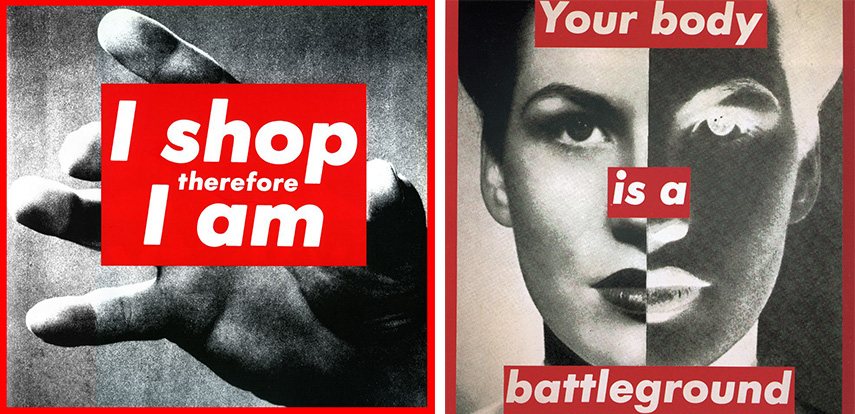
                                   
                                        Barbara Kruger, I shop therefore I am,     Barbara Kruger, Your body is a battleground, 1989
                                          1987

        Born right in Newark NJ, Barbara Kruger had a pretty typical and comfortable upbringing. Her mother worked as a legal secretary and her father worked as a chemical technician. She went to Syracuse University but left a year later due to the passing of her father. Kruger soon realizes her passion for art and graphic design and began a semester at Parson's School of Design in New York. Kruger, from there, works in freelancing art, graphic design magazine gigs, creating book-jacket covers and soon involving some poetry in her works. Barbara developed a great interest in poetry and began to attend many poetry readings and writings. From then on, her love for design and sending a message about the current uprising political issues soared through many publications. What makes Barbara's work so striking is that she makes the viewer really think. Her word choices and phrasing digs inside the readers head and allows the reader to think about the message in the context of the picture. 

       Many of Kruger's designs contain messages, even Kruger has mentioned that "I work with pictures and words because they have the ability to determine who we are and who we aren't." (Wayback Magazine 2010). Her ability to use text and photo/film to manipulate people thoughts to think about the bigger political messages. One of the pictures above says, "Your body is a battleground". This piece of art was originally designed for a pro-choice rally during the equal rights movement in Washington 1989. The image of the woman with two sides to her face gives many an opinion to what they think could be Kruger's message. Her works were more advertisements for strength. It uplifts women by comparing a woman's body to a battleground because of the constant debate over the issue on what women should do to their bodies during childbirth. The use of red as the only color in Kruger's designs draws an urgency to her already controversial work. The red creates the urgent and dangerous power dynamic and most likely was chosen to make viewers feel the cautious message of social stereotypes and political opinion since red is used for situations of intensity that is used to get people to pay attention to something. Such as red lights telling people to stop immediately and red alerts which are used in situations of danger.  Kruger's images cause viewers to analyze and stop to think that this constant struggle for control over women's bodies. Kruger's art is meant to empower women and cause the public to think using images and cliche phrases to critique a certain element in sexism and other controversial issues. 

More info on Kruger's message, artwork, and exhibitions: 
Portrait of Barbara Kruger
http://www.barbarakruger.com/


Mini Post: American People Series #20: Die


American People Series #20: Die 


Image result for American People Series #20; Die
Most of Ringgold's paintings represent the random violence and the race riots that existed in the early1960s. During that period of time, racism was still going on and it was only getting worse. Faith Ringgold, an African American woman who lived in that period of time, her only way of expressing her anger and sadness towards the treatment of her and her people was through art. She used the “Die” painting from her “American People Series” specifically to illustrate the randomness of the violence and racism that was happening at that time period. Therefore, we see that idea being symbolized in “the repeating adult figures” and the way that they were dressed. The exterior look of the characters in the artwork represents the idea that no one in the society is safe from violence. If we were to look closely at the figures that are painted, we see that everyone was afraid and horrified for their life, it didn't matter race or color of skin. Both black and white society members were fleeing. Adding on to that, if we look closely at the colors of the men's clothing, which is black and white, we realize that the emphasizes on that is that racism is the beginning of all violence. Another symbolic element is the two children that are holding/hugging each other in the middle of the artwork. They are from two completely different race, but yet have the same enemy, same mission, and the same fear. The main message and idea that Ringgold was trying to spread to her audience is that at the end of the day, we are all humans and we all have the same enemy, and dividing each other by skin color and differences in looks and culture will only cause more violence. No one is free from violence and pain. 


Source Link:https://www.theartstory.org/artist-ringgold-faith-artworks.htm

Mini Post: Favianna Rodriguez

Favianna Rodriguez is a U.S.-born, Latina artist, who is known for her multi-colored posters that address social justice issues. She was born on September 26, 1978 in Oakland, California and was raised upon Peruvian parents. Her parents first migrated to California from Peru in the late 1960s and her parents have supported Favianna's artistic talents since primary school, where she had won different awards. At the age of 20, she left the University of California Berkeley and wanted to pursue a career in political art. She is the Executive Director and co-founder of "CultureStrike", where national networks of artists and activists support the national and global arts movement around immigration.


One of her most famous artwork is entitled, "Migration is Beautiful", where a monarch butterfly is outlined and the wings are decorated. In her own words, the monarch butterfly symbolizes "the right that living beings have to freely move". In today's society, human beings are crossing borders in order to survive for themselves and their families. The wings are decorated with human profiles and shows the unity of people coming together for survival.

2013
http://favianna.flyingcart.com/index.php?p=detail&pid=430&cat_id=

Mini Post: Helen Frankenthaler

Helen Frankenthaler was born on December 12, 1928, and raised in New York City. She was the daughter of New York State Supreme Court Justice Alfred Frankenthaler and his wife Marth Frankenthaler. She received her earliest art instruction from Rufino Tamayo at Dalton School. She later graduated from Bennington College in 1949, where she was a student of Paul Feeley.

Helen Frankenthaler is known to be one of the great American artists of the twentieth century. Frankenthaler invented a technique named soak stain in which she heavily diluted an unprimed canvas with turpentine. She laid the canvas on the floor of her studio and poured the thinned paint directly onto the unprimed canvas. Through this invention, she was able to expand the possibilities of abstract painting. Her work has made a huge impact on contemporary art to this day. Her career as an artist took off when Adolph Gottlieb selected her painting Beach (1950) for inclusion in the exhibition titled Fifteen Unknowns: Selected by Artists of the Koots Gallery. Her soak stain technique had made a breakthrough with her Mountains and Sea painting in 1952. This painting quickly became influential for artists who formed the Color Field school of painting. Recent major exhibitions have included many of Helen Frankenthaler's paintings. Frankenthaler has also been the subject of numerous scholarly articles on her work. Articles that were written by renowned art historians, curators, and critics. In 2001, she received the National Medal of Arts. The 3 paintings shown below are 3 of many paintings; Mountains and Sea (1952), Jacob's Ladder (1957), and Nature Abhors a Vacuum (1973).

image
Mountains and Sea, 1952

image
Jacob's Ladder, 1957

image
Nature Abhors a Vacuum,1973


Link: http://www.frankenthalerfoundation.org/helen/biography

Mini Post: Tracey Emin


Image result for tracey eminTracey Emin, born 1963 in Surrey, England is known for her raw confessional artwork. Emin shocked the public with her work "My Bed" and "Everyone I Have Ever Slept With". At the age of 13, Emin was raped and it was not reported because "it happened to a lot of girls". She was raised by a single mother along with her twin brother.
Image result for tracey emin work
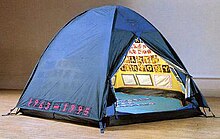
Emin's work lacks in symbolism which leaves her audience to view the reality of femininity. In her work ,"My Bed" it gives out en essece of depression and self-harm. Around the bed, there's scattered condoms and a blood-stained underwear. "Everyone I Have Ever Slept With" is a tent with the names of everyone that Tracey Emin has slept with (pretty self-explanatory right?). The people that Emin "slept with" were not all sexual partners which many misinterpret, they were actually people she fell asleep with.
  
Her work is praised for the way that she portrays the anxieties of a women's life.

 https://www.theartstory.org/artist-emin-tracey-life-and-legacy.htm#biography_header

Shirin Neshat's "Women of Allah"


“Women of Allah is supposed to be sympathetic, but also disturbing. Every image tried to frame that paradox: the woman who gives birth, is attractive and believes in God, but is also very brutal, very violent, a killer.” - Shirin Neshat


Rebellious Silence as part of the Women of Allah series 
Shirin Neshat is an Iranian artist who left her home country in the years following the way. Pursuing a career in the arts, she attended UC - Berkeley and drew inspiration from artists like Frida Kahlo. After seventeen years in the United States she eventually returned home to find unexpected consequences from the war. While society tells her that she should be subservient, during the war, several Muslim women were encouraged to be martyrs and fight for the cause. Addressing what she refers to as the contradiction of Islamic society, she published a collection entitled “Women of Allah.”

The photograph above labeled "Rebellious Silence" has two main elements to it. Both the woman, and the gun immediately stand out. Almost as if it is shushing her, the gun parts her face in half referring to the quiet subservience girls must possess, but also acknowledging the violent aspects of a women. Both nurturer and a killer during the war, these juxtapositions stood out to Neshat. In particular, the women's gaze at the viewer is quite interesting. While she does confront the viewer, she bears a gaze that is labelled as "submissive." Using her hijab along with the words on her face to cover her the way a burqa would, this does not mean that it oppresses her. Rather, the words that are written on her face actually encourage martyrdom and doing so because of God's love. Tackling with both empowerment and oppression, the gun she possesses is extremely powerful while also condemning her in a way. Thus, Neshat's work is a strong political commentary on the roles that women possess. Equally capable of being tender and powerful, a woman does not have to be limited to only a particular set of characteristics.


Mini Post: Uzumaki Cepeda

 Meet Uzumaki Cepeda, a young and extremely talented artist who drills into her memories and desires for inspiration to create. She grew up in the Bronx and is currently based in L.A but is originally from the Dominican Republic. Growing up, Cepeda moved around a lot which paired with her lack of stability and low-income family upbringing, fuels her yearning to be as visual and colorful as she can get when telling her story.
Cepeda believes in only photographing women of color, to draw attention to how important it is to include the women she grew up admiring. The Afro-Latinx community around her became a shelter for her to run to for not only support but also as inspiration. By doing so, she honors the tradition of her culture and allows it to grow while also maintaining inclusivity which brings power to her art.
Her work ranges from photographs to paintings to various installations, each more colorful than the next. She uses faux fur in a complex plethora of ways, whether it be to create a nail art or as the compost and soil used to nourish a plant. Each piece of her work is vibrant with color to remind her of her childhood’s beauty and pain and she uses that to further identify herself as the powerful artist she continues to be. 

 from top to bottom:
 "Mama"
"Nails"
"Safespace"

https://www.uzumaki.gallery/