Friday, March 8, 2019

Reflections on "No More Hidden Figures"

The first slide from the event slideshow, taken from my phone

On Wednesday, the event entitled "No More Hidden Figures: Honoring and Recognizing the SHEroes Among Us" honored five women whose work for Newark and beyond exemplifies excellence and dedication to the communities in which they serve. Lasting for roughly 90 minutes, the event featured two performances from local artists -- one of whom is a Rutgers student -- as well as a panel, Q&A, and awards ceremony.

I initially thought it was only a panel and figured I could fit it in between class and a scheduled meeting, but I was pleasantly surprised by the rest of the event and ended up staying for the whole time (even past my meeting time --- this is why you research things before you do them). The performances were inspiring, if a bit short and abrupt, but I thought it was neat that they proceeded the panel. 

Speaking of which, the panel proper was eye-opening. It consisted of five people, two moderators and three panelists, and the main discussion centered around representation and visibility. One of the questions in particular dealt with the topic of censorship and whether any of the women actively censored any people or groups in their work (which I think they deftly maneuvered around, not out of avoidance but out of respect perhaps). This portion was half an hour or so long, and it was followed by a brief audience Q&A, which all seemed to circle around self-care and how people of various circumstances -- specifically disability was mentioned -- intersect with the artists' work and their missions (I'll be honest, I have a terrible memory so I can't 100% say this is exactly how it went, but it was something along those lines). Overall, the speaking portion of the event was both the longest and the best.

The awards ceremony was quite short, consisting only of a video of last year's winners wishing this year's recipients well and the giving out of awards. After all winners receiving their gifts, a large photo shoot happened and then the audience was dismissed to get food and mingle. I left after this part so I could try and still make my meeting (spoiler: I did), but ultimately I thought this event was a success.

As someone both new to college and Newark/New Jersey, I learned a ton about the work people do in this community and the efforts to which people, and women of color in particular, fight for change and equality for all. While I may not pursue exactly the same paths as many of the women involved in the event, I have a wider sense of what is available and what is possible with the resources and people available to me. I would definitely attend this event and any like it in the future, and I wholeheartedly recommend it.

Gender Roles, Subject and Power


Gender, Subject, + Power

Though women historically have been seen and treated as inferior to men, the degrees of freedom and ability they exhibited have varied as time has progressed. As discussed in Chapter One of Whitney Chadwick's Women, Art, and Society, recent findings have suggested that the economic and social circumstances not affected by the omnipresence of the Christian Church allowed for greater freedom for women, in terms of managing the family's property and producing goods. However, these revelations have not negated the well-understood oppression and mistreatment of women since the Middle Ages. In any case, the ways in which women performed and maintained the roles society imposed on them have dramatically evolved from the Middle Ages into the 19th century.

Religion continued to dominate society in the Middle Ages, and it dictated the ways in which women could exist and be remembered. Chadwick made clear in the beginning of Chapter One that social historians' recent findings about women in the time period were "ambiguous", but that there did exist evidence of their lives being "shaped by economic and social forces outside ecclesiastic control, at least during the period of the early Middle Ages" (Chadwick 44). The lack of physical boundaries between domestic and public life, as well as documentation of involvement in masonry and building, are examples given in the text to support Chadwick's claim. And, in terms of the art of the period, women were often represented as laborers in manuscript illustration, embroidery, and paintings.

Monasteries were key centers of art production, which explained the continuing depictions of divine womanhood, as seen with the "apogee in the twelfth-century cult of the Virgin Mary" (Chadwick 45). However, this did not mean female nuns were treated equally in all aspects; women were allowed to convert to nuns and learn what was taught by men, but they could do nothing beyond that besides being depicted by male artists. An important exception to this was the so-called Beatus Apocalypse of Gerona, a manuscript worked on in part by a woman (whose self-chosen title was Depintrix, or "painteress") named Ende (Guerrilla Girls 20). Whether she was a nun or not is uncertain, but nonetheless, she was the first female Spanish manuscript illustrator and one whose work remains known to this day. Also of note are the works of German nun Hildegard of Bingen and French court writer Christine de Pisan. Hildegard and her work Scivias, as well as Pisan's allegory The City of Ladies, exemplified the trend of religious creation and influence. Both women, along with Ende, lived on as role models for other female artists, and their lives served as necessary foils to the situations of artists later in history.

Hildegard of Bingen, from Scivias (c. 1142-52)

In contrast, the Renaissance saw a notable shift toward enhanced separation and degradation of women, in both society and the art world, that continued into the 18th and 19th centuries. Despite the claims of Renaissance scholar Jacob Burckhardt, women were not seen as equal to men in that time period. In fact, a 1971 essay by Linda Nochlin "inaugurated feminist challenges to the prevailing view of Renaissance art as a naturalistic reflection of the reality rather than a set of constructed and gendered myths" (Chadwick 66). Chadwick notes the impact of capitalism and the modern state as catalysts for new economic, social, and familial dynamics in Renaissance Italy (and across the world). An already increasing idea of "masculinity" and "femininity" skyrocketed, and women found themselves being the product of art more than the producer. Power and wealth were concentrated in the more conservative art hubs of Florence and Rome, but exceptions such as the city of Cremona allowed women such as Sofonisba Anguissola to flourish in the 16th century. However, as the Guerrilla Girls point out in Chapter 3 of their book, she was "a noble whose father believed women should be educated", meaning his sending her work to Michaelangelo was the only reason her career got underfoot (Guerrilla Girls 29). Noting that is not meant to discredit his efforts, as it can be argued that familial help is surely a sign of progress, but it said much about the time that a man had to convince another man of a woman's worth. Male approval, not to mention one with immense power and wealth, gave and continues to give women's work value. So, although Sofonisba possessed a high level of talent and capacity before and without the recognition, the master's gaze was what allowed her work to be considered and, ultimately, remembered.

Sofonisba Anguissola, "Queen Anne of Austria" (1570)

Anguissola was one of many women artists popular during the Renaissance, and her contemporaries included the likes of Elisabetta Sirani and the famed Artemisia Gentileschi. The works of Sirani and Gentileschi also posed questions about the lengths women had to go through to be recognized and taken seriously. Sirani became immensely popular during her lifetime, to the point of being "accused of signing work her father had done" and having to "paint in public and [opening] a school for women artists" (Guerrilla Girls 30). Beyond just that, her well-known piece entitled "Portia Wounding Her Thigh" was a blatant example of women bending-over-backward and hurting themselves to prove their allegiance and value. In the story of Julius Caesar, Portia literally wounded her thigh in order to prove to her husband Brutus that she was trustworthy. She became a representative of all the women who experienced similar things (be it with self-inflicted harm or otherwise), as well as of women in general. However, she also stood for the divide between women for male attention, a phenomenon created by the men of the patriarchy and spurred on by the male gaze. In order to distance herself from other women, who could not be trusted with such secrets and dangerous details, she had to lacerate her leg. Often, women must prove their worth and individuality by distancing themselves from other women because of the stereotypes surrounding them. "I'm not like other girls" is a common phrase meant to distinguish a stronger, more capable woman from other, lesser ones, but what it does is reinforce the male gaze and group all females who utter the same words together anyway. Perhaps it works in the short term but, as the treatment of women who rise to prominence in the 18th and 19th centuries demonstrates, Portia may be a powerful figure in the painting but an incomplete representation of empowerment in real life.

Elisabetta Sirani, "Portia Wounding Her Thigh" (1664)

Come the late 1700s and early 1800s, more female artists began forcing themselves into predominantly male spaces, such as France's Royal Academy of Painting and Sculpture, for both better and worse. Two of the most famous artists of the time were Elisabeth Vigée Le Brun and Adélaïde Labille-Guiard, both of whom were frequently commissioned for their portraits and historical paintings. Vigée Le Brun, in particular, was hailed as one of Marie Antoinette's favorite portraitists (see "Marie Antoinette and Her Children" below). As Le Brun and Labille-Guiard joined the Academy on the same date in 1783, they became press spectacles. On the one hand, many critics applauded their fame and prominence, but just as many degraded them and their work, spread false rumors, and declared them "rivals" with little basis (a common argument was that Le Brun's work was "feminine" and Labille-Guiard's was "masculine" in their brushstrokes, color, and depiction of subjects). This fabricated duel between two equally accomplished and skilled painters was another such way patriarchy continued to lord over society. While both women gained the recognition they deserved, their careers were pitted each other by men afraid to be overshadowed in their own stomping grounds. Like Portia wounding her thigh, Le Brun and Labille-Guiard were made to fight each other for a seat at the men's table. Their excellence, skill, and subjects mattered not, though their very existence within the Royal Academy was, in itself, instrumental progress in moving toward equality among artists.

Elisabeth Vigée Le Brun, "Marie Antoinette and Her Children" (1787) 

Women's roles in art and society have transformed throughout history based on the power of religion and the strength of the patriarchy at the time. The early Middle Ages contained several instances in which men and women shared relative equality but, even then and in later eras, there has never been total respect and opportunities for women. What this meant for the 20th century was that there was much work to be done, in order to allow women, artists or otherwise, to play on the same field as men. And, as is known now in the 21st century, is that there was indeed much progress for equality and opportunity, but there remain far more barriers to overcome for people and artists of all genders and backgrounds to be truly equal.

Works Cited
Auricchio, Laura. “Eighteenth-Century Women Painters in France.” In Heilbrunn Timeline of Art History. New York: The Metropolitan Museum of Art, 2000–. http://www.metmuseum.org/toah/hd/18wa/hd_18wa.htm (October 2004)
Chadwick, Whitney. Women, Art and Society. 5th ed., Thames and Hudson, 2012.
Guerrilla Girls. The Guerrilla Girls' Bedside Companion to the History of Western Art. Penguin Books, 1998.
Nochlin, Linda. “From 1971: Why Have There Been No Great Women Artists? -.” ARTnews, ARTNews Media, LLC, 24 Sept. 2018, www.artnews.com/2015/05/30/why-have-there-been-no-great-women-artists/.

Gender Roles, Subject and Power

     As women, they always had certain gender roles that they had to follow, so men were always superior to women. Men artists had the power and superiority in the arts compared to women artists. Men’s artworks were always looked at as better and was more accepted in society compared to women’s artwork. Men had dominance in the art world that women could not compete with because of their gender. Women were considered the caregivers of the family, so they were not taken as seriously as artists. They were looked at as inferior to a man in society, so their roles were different from the roles’ of a man. “Women were supposed to be seen and not heard … Females were able to speak their minds but their thoughts and ideas were shaped by men” (Cloud 1). A woman’s world revolved around men because men controlled everything a woman says and does. A women’s role was to be obedient and submit to men. St. Paul said “a woman must be a learner, listening quietly and with due submission. I do not permit a woman to be a teacher, nor must a woman domineer over a man; she should be quiet” (Chadwick, 45).
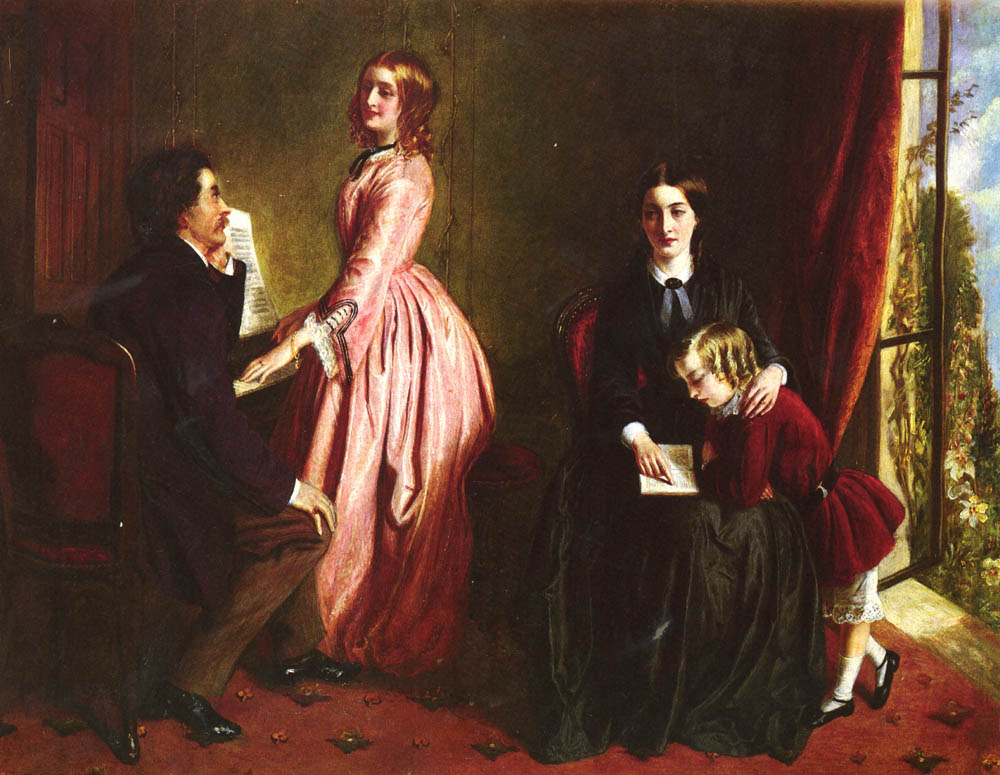
Rebecca Solomon, The Governess, 1853
The painting shows the gender roles as a wife.
     A painting that shows woman’s gender roles is The Governess by Rebecca Solomon. In the painting, Solomon highlights a woman in a pink dress as the wife and the lady of the household. The woman in the pink dress is young and well dressed, which is the ideal feminine image. The woman in the pink dress is shown entertaining the man of the house, which depicts the woman gender role as being an object for men.
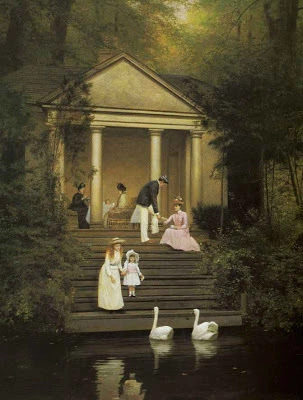
Edith Hayllar, Feeding the Swans, 1889
It shows the gender roles of women in the upper middle class as they age.
  Women in different classes had different roles in society, but all women were still inferior to the men in their lives and their role was to take care of the household whatever their class was. “Low class women were expected to be housewives and take care of everything to do with the house ... The expectation of working class women was ... to work for their husbands and help them run their business ... Upper class women may have had servants and workers working for them but the women were still expected to take care of the house hold” (Cloud 1). An example of the upper-class women gender roles is in Edith Hayllar, Feeding the Swans. The painting shows the roles of women from Victoria England. The picture depicts two girls below the steps to show how from a young age, woman are domestic caretakers. The higher you are up to the steps, the older you are in the female lifetime. Up the steps, it shows a woman getting courted, which shows the role of a woman finding a man to marry.
     “Revolutionary thinkers like Rousseau saw a woman's place, according to both ‘nature’ and ‘reason,’ to be in her home, taking care of those around her” (Guerrilla Girls 39). The expected roles of women in Europe during the Middle Ages was taking care of the home and family. It was a woman’s duty to be a housewife and they were expected to do whatever their husband said. If they were not staying at home, they had very simple jobs. “Women were relegated to unskilled activities in the guilds at an historical moment when the demand was growing for ‘designers’ who could plan patterns for figured cloths and style the finished pieces” (Chadwick 69). Since society believed that women were not capable of doing regular jobs, they were assigned jobs that required no intelligence or experience. Society believed that women were weaker, less intelligent, and could not do the same jobs as men.
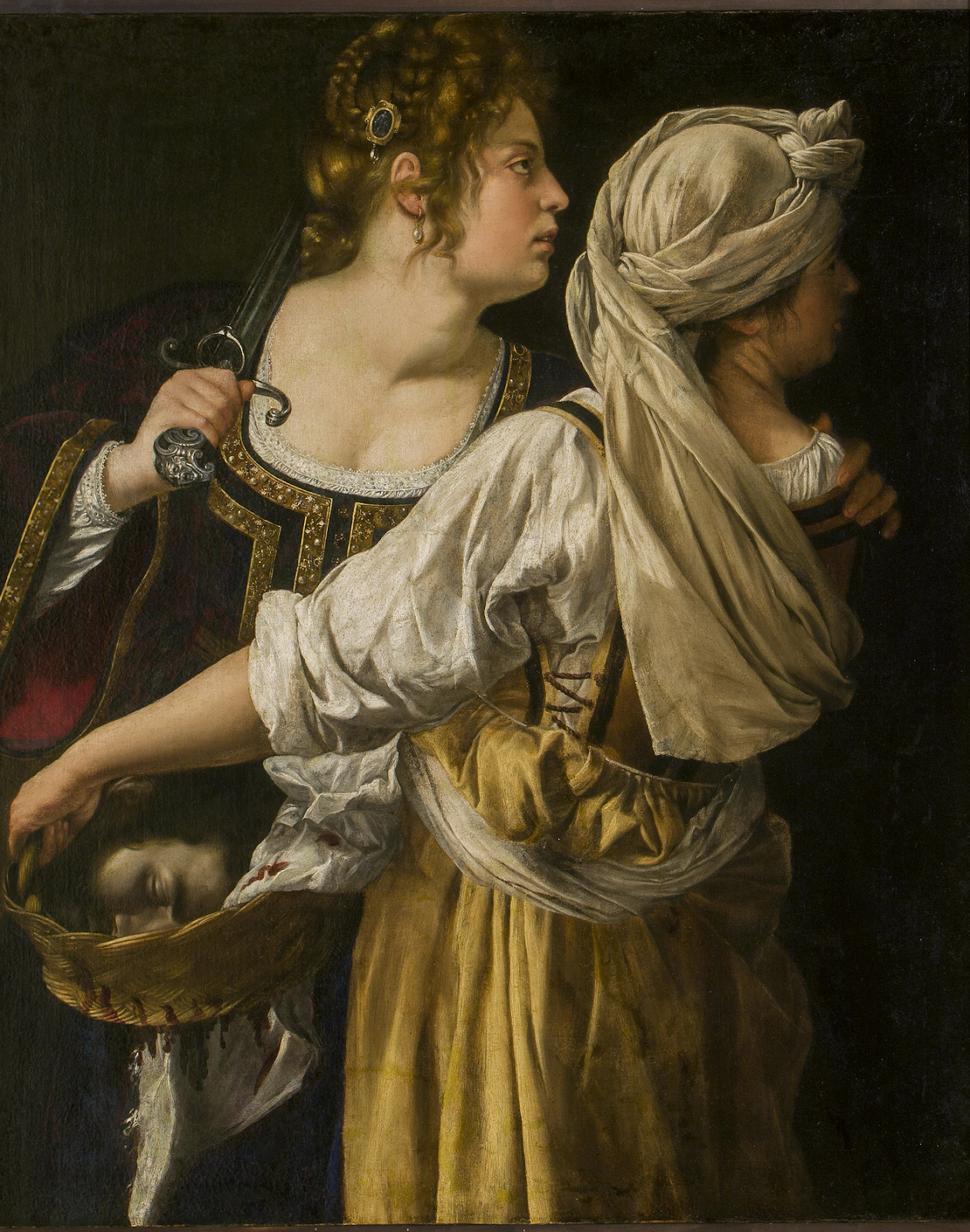
Artemisia Gentileschi, Judith and her Maidservant, 1618
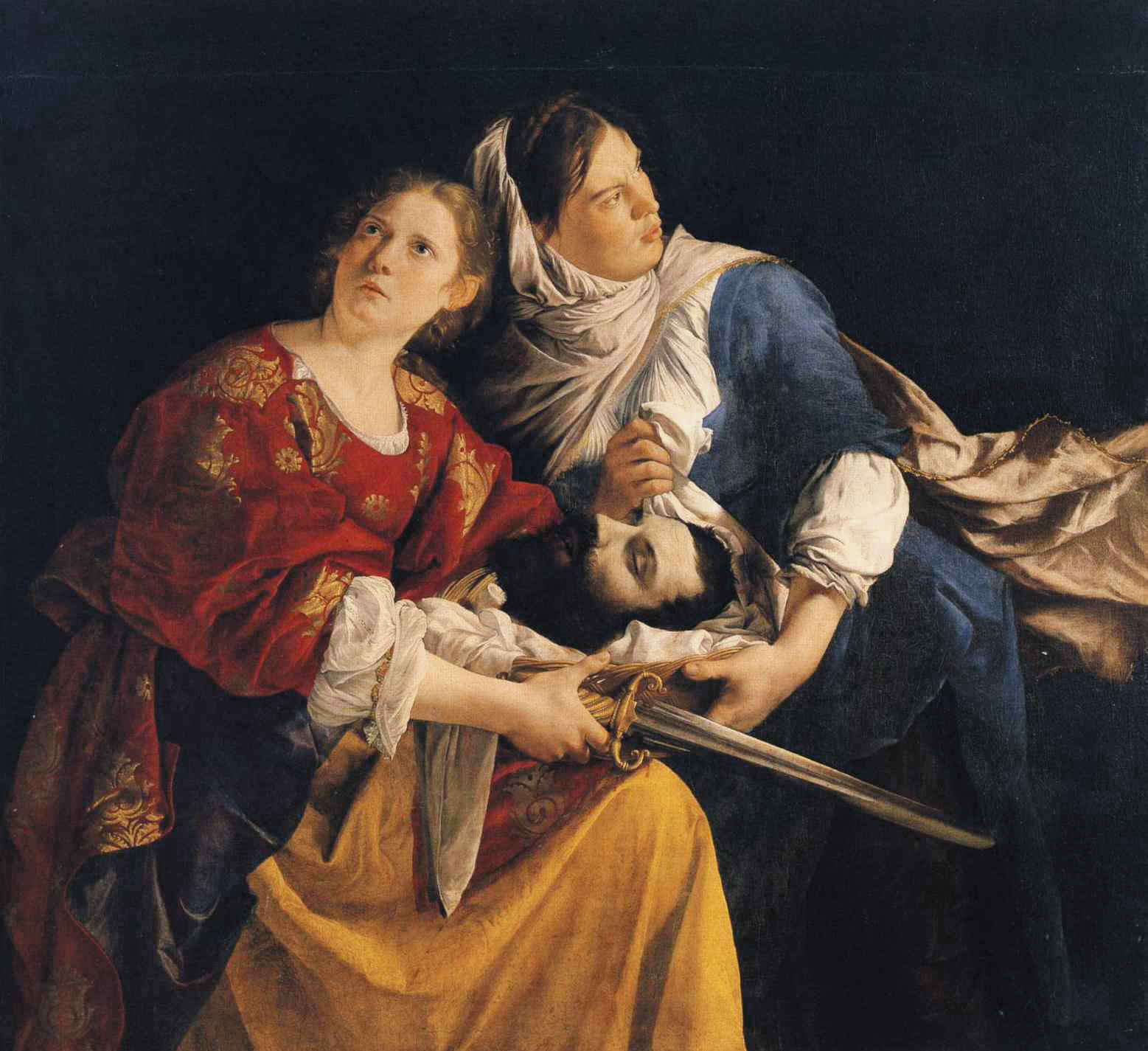
Orazio Gentileschi, Judith and her Maidservant, 1610 
The two paintings of Judith and her Maidservant by Artemisia Gentileschi and Orazio Gentileschi shows the different perspectives on women’s gender roles from a woman and male artists.

     Roles changed throughout the Renaissance and into the 19C because society has grown more accepting to women artists. Since the 16th century, most of the female artists were lucky enough to become an artist with help from their father. Artist like Artemisia Gentileschi had an artist father, Orazio Gentileschi that accepted her talents even though she were female. Even though he accepted her as an artist, he still believed that men were superior to women. Judith and the Maidservant is a story of Judith and her maidservant slaying the Holofernes, the Syrian King who brought danger to her community. The daughter and father duo both painted Judith and her Maidservant, but depicted the women in the painting in different ways. Orazio Gentileschi depicts the women as being dazed and confused about what to do after killing the Holofernes. He wants to show how women are weak and their job is to nurture and not to kill. On the other hand, Artemisia Gentileschi shows Judith and her maidservant as brave and knowing what to do after killing the Syrian King. The Gentileschis both painted the same situation but painted them differently from dissimilar women gender roles perspectives.
     In the 19th century, female artists became more well known, but it also depended on where they lived and if they were wealthy. “Geography and class played a significant role in shaping the experience of nineteenth-century American women artists” (Chadwick 211). Where the women lived and if they were rich or poor affected if the women artist was successful or not, and it also depended on their location because some places may be more acceptable to women artists than others.
     Even though women were becoming more popular from their artwork, they were still not considered equal to men. “Sensitive to the implication of exhibiting women’s art only in relation to other areas of feminine creative activity, and angered because no attention was given to women’s wages and working conditions” (Chadwick 228). Even as time went by, women were still not looked at seriously and society did not care about women, so female artists were being overlooked. Society mainly concentrated on art made by men and disregarded women. Men were treated with more respect and importance compared to women.

Works Cited

Chadwick, Whitney. Women, Art, and Society. Thames & Hudson, 2012.

Cloud, Amanda. “Gender Roles of Women in the Renaissance.” Gender Roles of Women in the Renaissance, www2.cedarcrest.edu/academic/eng/lfletcher/shrew/acloud.htm.

Girls, Guerrilla. The Guerrilla Girls Bedside Companion to the History of Western Art. Penguin Books, 2006.

Gender Roles, Subject, and Power


The role of women in Europe in the middle ages was seen as a second-class role. They had to listen to their husbands, take care of their children, and keep the household in order. The women at this time were married young and it was often arranged by their parents. This role was mainly dictated by the catholic church which held jurisdiction over the social norms at this time. Ironically, the church also provided women with the only way they could live their life as a single free woman, as a nun. In this sense women are never actually alone and free, they always have to be governed by someone or something. In relation to women in fields of art, it was difficult for them to make breakthrough work since they had no platform to create through. Women were not taught, apprenticed, or able to be educated unless they had wealth and so those who created artwork were often overlooked. This was seen especially in both the regular every day, and religious space. Although women usually held important roles in the church they were still seen as inferior and less educated in comparison to the male authority.

Women in the religious world were even seen as lower class although they may have held high positions. They were often not given the opportunity to contribute to the debates surrounding the church. During this medieval pe


riod, Hildegard of Bingen and Herrad of Landsburg both defied their roles as women in the church by creating breakthrough work. Hildegard made The Scivas while Herrad made the Hortus Deliciarum. They are described as “two of the most remarkable religious compilations by women in western history” (Chadwick 55). Herrad, who dedicated the Hortus Deliciarum to the women in her convent, addresses each of them by name in one of her illustrations. As women were often looked over, Herrad makes each of them known and has permanently etched them into the history of the church so that they may be seen for the significance and service they actually provided instead of being disregarded. Hildegard does the same, in her religious texts she provides insight to the religious experiences that she has had in her lifetime. Although both of these women created powerful works that gave rise to the importance of women in medieval society, it did not challenge the ideas of women in the church: men have control over knowledge since they do not separate the body of a woman from her thoughts. Rather, these works provided a “strong sense of female otherness in relation to male authority and a vision of woman as complementary to a man” (Chadwick). Hildegard and Herrad’s work did not undercut the education and capability of women and women in convent, while the works of male writers and artists during this time period did. Both artists also redefine what it means to be a female in the church and present female power as a natural order in a way that doesn’t combat the competency and institution of male authority – they demonstrate that both female and male authority can go hand in hand.

As time moves on eventually in the 19th century the roles of women have changed, women are now starting to make their way into professionalism in art through education. The education reform for women during this time period was quite drastic. Several art schools popped up in America around the 19th century which taught painting, drawing, and skills like embroidery, lace making, dancing, and music (Chadwick 178). All women art schools which were slowly starting to pop up were a great benefit to women who were often segregated by a male dominated field where they would have normally had to attend a school with all males to get any type of education whatsoever. The effect that this had on the artwork of women was obvious, as it gave them a platform to create work to express themselves.

As women move into different professions in the 19th century, new problems for them arise and are addressed and reflected through the artwork of women. For example, The Seamstress by Anna Blunden depicts the struggle of a woman trying to earn her own living. This idea goes against the way women were thought of and portrayed in the artwork of the medieval times, its “quasi-religious tone, as a woman who has been laboring throughout the night clasps her hands and gazes heavenward at the light of day, contrasts sharply with the reality of laboring for hours over the tiny stitches of a mans dress shirt” (Chadwick 188). It is also evident that women are starting to become more independent during this time period as their work started to reflect their want for freedom and release of male authority. Rosa Bonhheur often illustrated animals and her work The Horse Fair can be equated to the freedom she wished for herself as a female. She was an artist who had to obtain legal permission to cross-dress in order for her to travel the world and find places of inspiration and make her artwork. Although the platform for women in art was slightly raised, it is obviously still very difficult for them to make any breakthroughs without the help of wealth or a male. The small amount of freedom that women were able to achieve had a full impact on the political front at this time as the first United States National Women’s Rights Movement emerged which ignites a new spirit within woman that wasn’t there before. Although the 19th century provided grounds for many important breakthroughs not only in art for women, but in the workforce, politics, household, and more, women were still very restricted in comparison to men. Men are still seen as the figure of authority largely because of the institution of this law by the church so long ago, and because of the societal norms of patriarchy and the glaring male gaze. Women are unfortunately left still questioning their role in a gender segregated space.

Chadwick, Whitney. Women, Art, and Society. Langara College, 2016.

The Guerrilla Girls' Bedside Companion to the History of Western Art. Penguin Books, 2006.

Gender Roles, Subject, and Power

The expected roles of women in Europe in the Middle Ages were to be present, or even to be something to be looked at. Women are thought to be better as mothers, wives, instead of intellectual creatures. Women were not equal to men which created an idea that women were incapable of doing work that men can do, and often women’s art was ignored. Women were thought as the caregivers versus men were the breadwinners. Women were believed to be for the eye of a man, and if a woman was not married she was not seen as fulfilled.
Throughout the renaissance the roles of women changed and were showcased through Art. In the Middle Ages, there were artists such as Christine Pis(z)an, who painted a portrait of herself called Christine Pis(z)an in her study, from 1405. During this time, it was rare for a woman to pursue art. Christine Pis(z)an advocated for women’s equality, and was very involved in speaking up for women. She did many things in her time. Not only did she paint, she also made poetry, constructed novels, autobiographies, and along with other crafts. This was not common for the average women at this time. The brooklyn museum describes her as a feminist, and states, “Her works, considered to be some of the earliest feminist writings, include poetry, novels, biography, and autobiography, as well as literary, political, and religious commentary. De Pisan became the first woman in France, and possibly Europe, to earn a living solely by writing.”. Christine Pis(z)an was an influential woman who would inspire other women to follow her footsteps to pursue art. At that time women were not allowed to read, especially poorer classes. The article tells us Pis(z)an wrote for the women who were able to actually read. It says, “Although de Pisan’s work was primarily written for and about the upper classes (the majority of lower class women were illiterate), her writing was instrumental in introducing the concept of equality and justice for women in medieval France. De Pisan lived the majority of her life in relative comfort, and in 1418, she entered a convent in” Poissy (northwest of Paris), where she continued to produce work, including her last poem Le Ditie de Jeanne d’Arc (Song in Honor of Joan of Arc), 1429.”. This shows us that the artist made justice for women her main goal to keep speaking about the inequalities that were not seen during the Middle Ages. In Guerilla Girls, it tells us that Christine was killed for her ideology. The book states, “Christine died in exile, before Charles was back in charge. Joan stood next to Charles at his coronation, then he turned her over to English sympathizers, who branded her a witch and a heretic. She was burned at the stake in 1431 for those offenses, and also because she refused to stop wearing men’s clothes. Eventually the church made her a saint.”. Even when women are trying to work towards bettering the future and breaking through gender norms, they are punished for it.
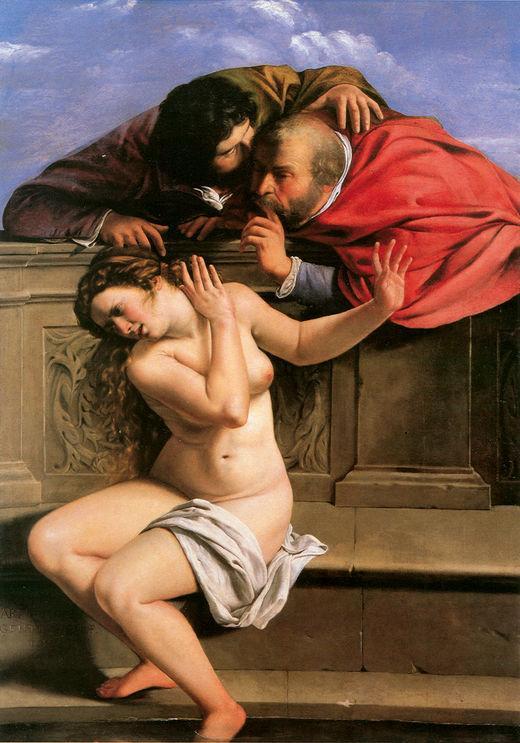
During the renaissance, it was still hard for women to pursue art or try to change the ways women were seen, but more and more women were going after art. Artists such as Artemisia Gentileschi, and Sofonisba Anguissola were very famous painters. Artemisia Gentileschi was following her father’s footsteps and creating art. When she was 17, and she had already so many paintings including the famous “Susanna and The Elders”. Which was earlier painted by Tintoretto in 1555. But Artemisia gave the painting a woman's interpretation because Osorio's painting makes the woman look graceful when she is going to be raped. Susanna and the Elders is the story of men trying to persuade a women to dishonor her husband. Her painting showed the woman rigid and Ozario’s painting shows a graceful woman. This tells two completely different perspectives to what actually happened. Ozario’s point of view was of a man’s, making the woman seem as if she did not mind being spoken to by the men. Where as Artemisia’s painting shows the woman pushing the men away and the man shushing her. Artemisia expressed her own rape and pain through her art, she showed justice through it. An article on Artemisia states, “Gentileschi subverted traditional depictions of the female protagonists of biblical and mythological stories presenting them as self-motivated heroines capable of making their own decisions rather than passive objects of the male gaze. In doing so she presented them in an entirely new way and this allowed them to possess a power that had been denied them by other artists.” Artemisia tried to show her own way of thinking in her art despite how men tried to display things.
In 19th century art, women became more free to express their feelings through art. Women were showcasing the inequalities much more by now. Artists such as Lily Martin Spencer, Harriet Powers, and Harriet Hosmer were transpiring ideas such as racial and gender equality. Chadwick describes these artists as “Although their work includes numerous representations of women, they often chose to depict strong, active females, and they struggled to escape the devaluation that accompanied the identification of their work as “feminine”.”(Chadwick 217). Women were undervalued to what their potential truly was. A woman's femininity was always looked at when she would put her art out. Also women only felt free through their friendships with other women which became an alternative to marriage.
Men were allowed to have work force jobs while women were seen to be housewives, or take care of children. When women tried to express their feelings through art, they were often ignored or not taken serious. This is a continuous issue for women until this day, women are not treated as men. Gender roles goes back before the Middle Ages and it still seen in 2019. Through Art women are given an outlet to express the inequality that makes them seem less than. Female artists tell stories and help other women overcome problems we face due to injustices.

*Artemisia Gentileschi, Susanna and the Elders, 1610
Related image

Tintoretto, Susanna and the Elders, 1555
Image result for *male artist Tintoretto, Susanna and the Elders, 1555


Christine De Piz(s)an,  Christine De Piz(s)an in her Study, from The City of Ladies, 1405
Related image
Works Cited

Chadwick, Whitney. Women, Art, and Society: Fourth Edition. Thames & Hudson, 2007.

“Christine De Pisan.” Brooklyn Museum: The Dinner Party by Judy Chicago, www.brooklynmuseum.org/eascfa/dinner_party/place_settings/christine_de_pisan.

“Gentileschi Paintings, Bio, Ideas.” The Art Story, www.theartstory.org/artist-gentileschi-artemisia.htm.

The Guerrilla Girls' beside Companion to the History of Western Art. 1998.


Gender Roles, Subject and Power

Throughout history, gender roles have played an integral part in forming a social hierarchy in which men mostly had all the power and women had virtually none. In most places, the power men had over women led to women being viewed as property and objects to men. This view of women being property and objects to men would establish a justification for men to restrict the opportunities for most women to only do housework and serving a man. This view led to women being confined within the domestic sphere of society and nothing else. The thought of women expanding upon this domestic sphere was considered ridiculous and in some time periods not even possible. Even with these obstacles, some women faced these challenges and looked to defy the constraints of gender roles in order to attain some kind of equality to men.

Hildegard of Bingen, Scivas c1142-52
This painting shows Hildegard having a vision from God and relaying it to man.
This painting illustrates how at the time most woman to have power
they would need God by there side to be taken seriously.  
In the Middle Ages, women's roles were defined within the context of biblical text and teachings. During this time period, gender roles were mainly established through the biblical story of "Adam and Eve." Men represented Adam who was strong and listened to God, while women were represented by Eve who was made by Adam's rib and who also tempted Adam to eat the forbidden fruit that gets them both punished by God. This biblical story was taught and reinforced within this time period to justify women as inferior sex to men. Due to women being looked at as inferior their only role in society was constrained within the domestic sphere of motherhood and housework with the exception of being involved with the church as a nun. Women being viewed only for the purpose of motherhood led to them being uneducated and illiterate, which The Guerrilla girls mention by stating, “education was thought to interfere with a woman’s ability to be a good wife and mother. Almost no women were taught to read and write.” (Guerrilla Girls 22). This quote shows how the main role of a woman was lock within the domestic walls of motherhood. The one exception though like previously mentioned was to be a nun for the church. Being a nun for the church was an exception because it allowed women to have some freedom from the constraints of motherhood and the risk of childbearing, as well as even allowed for some women to be in a position of power (i.e an abbess). One example of a woman being in power during the Middle Ages is Hildegard of Bingen. She was a nun who had visions from God which gave her the power to transcend the constraints of the social norms at the time. As illustrated in Hildegard of Bingen's painting "Scivas" she illustrates herself having a vision and relaying it to a man. Even with her visions she still views herself as a weak women and blessed enough to receive visions from God which Chadwick reiterates, “She herself claimed  to be nothing more than a receptor, ‘a feather on the breath of God.’ A gift from God to a weak but chosen woman, the vision circumvents the medieval Church’s denial of power or authority to women. It disrupts masculine control over knowledge by separating the body of a woman from thought.” (Chadwick 59). This quote showcases how even with her visions from God, Hildegard in some way must still conform with gender roles within the church because she is still viewed as a weak woman being blessed and privileged by God to see these visions and nothing more. Her visions are seen separate from her, her visions are viewed as God's thoughts not her own, while she herself is viewed as just a weak woman receiving gods thoughts and nothing more. Hildegard's power to receive these visions as a woman threatens the male patriarchy of the Middle Ages and is only accepted due to the power and belief of God's doing and not her own doing, which would go against the social norm and be problematic for the time.

Elisabetta Siriani, Portia Wounding her Thigh, 1664
This painting illustrates Portia wounding her thigh and separating herself from other females to signify
how she is a strong and trustworthy woman. Portia wounding herself is the center of attention
for this piece and the act of wounding herself is a masculine thing portraying how
she wants to be recognized as more than just another woman.  

In the Renaissance Age, women were still confined within the domestic sphere. Women were still oppressed by a patriarchal society where they were only viewed within the lens of being a daughter (owned by their father), then becoming a wife (owned by their husband), then becoming a mother (still owned by their husband). Even with these views of women, there were some rare exceptions for women to be involved in other lines of work only if their help was needed (i.e a wife of a merchant who helps out at the store). During this period most women still lacked opportunities outside the domestic sphere as mentioned in Gurriel Girls which states, “In most cities, women were barred from painters’ guilds or academies (except for the lace and silk makers’ guilds). They couldn’t receive commissions or legally own an atelier. Most were illiterate.  One of the few ways a woman can work as an artist was to be born into a family of artists that needed assistance in the family workshop.” (Guerrilla Girls 29). Even if women did their own works of art or own work, in general, it was still owned by their father or husband, which shows how low a woman was viewed at the time. It was hard for a woman to be something more or recognized as something more as a painting by Elisabetta Siriana "Portia Wounding her Thigh" depicts. Chadwick states “Sirani chose the moment at which Portia wounded herself to test her strength of character before asking Brutus to confide in her...Stabbing herself deeply in the thigh, Portia has to prove herself virtuous and worthy of political trust by separating herself from the rest of her sex.”(Chadwick 101). This painting focuses on Portia wounding her own thigh showcasing a masculine act, while also showing Portia separating herself from other women showcasing how she is more than just another woman she is strong, she is trustworthy. This painting symbolizes a woman who transcends the depiction of the average woman at the time and in doing so rejects her feminity in order to feel accepted by Brutus but more importantly feel accepted by society.   

Mary Cassatt, Woman in Black at the Opera, 1880
This painting illustrates a woman going to an Opera without a man wearing black. The black clothes symbolize a person not wanting to be noticed and the view of a male looking at this woman without a man by her side showcases the male gaze, which the male gaze can also be seen as how society views this woman who is going against social norms. 

 In the 19th-century gender roles were more defined than ever due to men always commuting to work and women restricted to housework all day. A woman's importance in this time relied once again within the domestic sphere, but even more importantly taking care of the next generation, her children. A woman's life was tied to the man she was with and there little she could do about it because the power and control lied within men, which the Guerrilla Girls mention by stating, "You could be used to symbolize democracy-E.G., The Statue of Liberty-but you weren’t allowed to vote... You could not be the legal guardian of your own children or hold a job without your husband’s permission." (Guerrilla Girls 52). In all aspects of society, a woman had no power, even legally. Women had no power and if they tried to go against these social norms they judged and criticized by society as can be seen in Mary Cassatt's painting "Women in Black at the Opera". This painting focuses on a woman who goes against social norms by going to an opera be herself without a man and becoming a spectator just like men. She is being watched by another guy across the opera, which shows the male gaze but not only just the male gaze but also society as a whole watching her and judging her. Another important aspect of the painting is the black the woman is wearing, this symbolizes that she doesn't want to be noticed by anyone and just wants to blend in, but as mention, before there is a guy staring at her, she is still the object for that man, for the male gaze and for the patriotical society.


In summary, women have always been constrained within the domestic sphere thanks to patriotical ideas reinforcing gender roles. Women have always been viewed as objects and properties to men and this kind of view of women still has prominence even today. Even though the times have changed gender roles and the view of women and their power in society is still lacking, even though it appears women may not be constrainted by gender roles nowadays, that is not the case, gender roles are more subtle nowadays and are represent within double standards for men. Even at a subtle level gender roles is still enforced in some households and is still deep in the roots of society. 


Works Cited
The Guerrilla Girls' beside Companion to the History of Western Art. 1998.

Chadwick, Whitney. Women, Art, and Society: Fourth Edition. Thames & Hudson, 2007.

“Women in Medieval Society.” The British Library, The British Library, 17 Jan. 2014, www.bl.uk/the-middle-ages/articles/women-in-medieval-society.

Renaissance, "Women in the, and Reformation.". “Women in the Renaissance and Reformation.” The Columbia Encyclopedia, 6th Ed, Encyclopedia.com, 2002, www.encyclopedia.com/history/encyclopedias-almanacs-transcripts-and-maps/women-renaissance-and-reformation.

“Gender Roles in the 19th Century.” The British Library, The British Library, 13 Feb. 2014, www.bl.uk/romantics-and-victorians/articles/gender-roles-in-the-19th-century.